

A flange joint may look simple: two pipe ends, a gasket, and a circle of bolts. In service, small accessory choices can affect sealing, alignment, corrosion resistance, and maintenance. This guide explores the top types of Flange Accessory used in 2026, with practical attention to where each item fits. The right choice depends on pressure, temperature, fluid, flange facing, and the equipment around the joint. A product that works well on a water line may not suit a hot process line.
Gaskets remain central because they create the seal between mating faces. Bolts, studs, and nuts provide the clamping force, while insulating kits help limit electrical contact between connected components. Spacers, blinds, and spectacle blinds support isolation or maintenance tasks when selected for the piping design. Flange protectors can also help keep faces clean during storage and transport. Details matter. A gasket’s material and dimensions should match the specified service conditions, and fasteners need compatible grades and tightening practices. In practice, installation quality can be just as important as the part itself.
The sections ahead compare common accessory types, their functions, and the factors buyers should check before ordering. Specifications and terminology can differ across industries and suppliers, so confirm dimensions and ratings against approved drawings and manufacturer data. There is no universal shortlist; that point is easy to overlook when comparing catalogues. Use this overview as a starting point, not a substitute for qualified engineering review.
ASME B16.20 covers three metallic gasket families: spiral-wound, metal-jacketed, and ring-joint. It sets requirements for dimensions, materials, and marking. A spiral-wound gasket combines a metal strip with soft filler, helping it handle temperature changes when correctly compressed. Metal-jacketed types enclose filler in a metal shell and are often used on heat exchangers. Ring-joint gaskets seat in machined flange grooves, where correct ring profile and groove fit matter. Small details matter.
The International Energy Agency’s Global Methane Tracker 2024 estimates that fossil-fuel operations emitted about 120 million tonnes of methane in 2023. This is a sector-wide estimate, not a measure of flange-gasket leaks. It does underline why reliable joint assembly matters. ASME PCC-1-2022 provides guidance for bolted-flange joint assembly, including controlled tightening practices. In the field, gasket choice still depends on pressure, temperature, fluid, flange finish, and maintenance history. Selection can feel less tidy when old drawings are incomplete.
Tips: Confirm the gasket’s ASME B16.20 type and dimensions against the flange. Check groove condition for ring joints, and use a documented tightening procedure. Never assume a gasket that fits is the right one.
Among flange accessories, stud bolts and nuts deserve careful attention because they hold the joint together under pressure and temperature changes. ASTM A193 Grade B7 stud bolts have a minimum tensile strength of 125 ksi for nominal diameters up to and including 2.5 inches. This is a material requirement, not a guarantee that every assembled flange will perform safely. Design, gasket selection, tightening method, and service conditions still matter.
B7 studs are commonly paired with ASTM A194 Grade 2H nuts when the project specification calls for that combination. Check the purchase documents and material certificates rather than relying on appearance alone. Look for clear grade markings, clean threads, and consistent dimensions. Small defects matter. During installation, use the specified tightening sequence and account for lubricant, since it can change the relationship between applied torque and bolt tension. That detail is easy to overlook. Also consider corrosion exposure and operating temperature when selecting materials. A familiar grade is not automatically right for every service, and field conditions can complicate a tidy specification. Verify the actual bolt diameter before applying the 125 ksi threshold.
Line blinds provide a visible way to isolate or reopen a section of piping. ASME B16.48 covers line blanks from NPS 1/2 through NPS 24, in Classes 150 through 2500. That range is broad, but it does not make every blank interchangeable. The selected dimensions and pressure-temperature limits must match the piping system.
A spectacle blind combines a solid plate and an open spacer in one assembly. Operators rotate it to change between blocked and open positions.
A paddle blind, also called a spade, blocks flow on its own; a separate spacer can be fitted when flow is restored.
The plate’s position is easy to see. That matters during maintenance.
Check flange facing, bolt pattern, material, gasket fit, and operating conditions before specifying a line blank. Class numbers are not pressure values by themselves; allowable pressure depends on factors such as material and temperature. A drawing can look clear and still omit a critical detail, so verify the flange interface against the applicable standard and project requirements. I would not treat a catalog size alone as proof of fit.
What Are the Top Types of Flange Accessories in 2026?
Flange Insulation Kits: Match ASME B16.5 Flanges Across Classes 150–2500
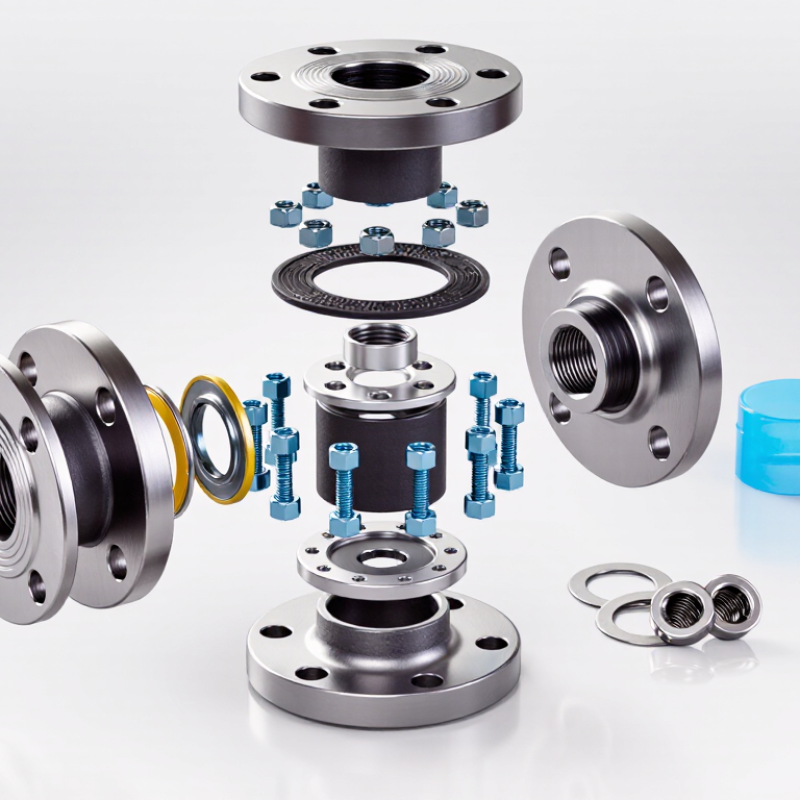
Flange insulation kits help limit electrical continuity between connected flanges, often as part of corrosion-control systems. A typical kit includes an insulating gasket, sleeves, and washers. Small parts matter. If a sleeve is too short or a washer is missing, the bolts may create an unintended conductive path.
For ASME B16.5 flanges, match the kit to the flange size, pressure class, facing, and bolt pattern. Classes range from 150 to 2500, but available size combinations vary. Check the flange markings and project drawings rather than relying on appearance alone. Raised-face and ring-type-joint connections may require different gasket designs, and the sealing material must suit the fluid, temperature, and operating conditions.
Installation deserves equal care. Keep sleeves centered in the bolt holes, avoid damaging the gasket, and tighten bolts in a controlled cross-pattern using the specified procedure. It sounds simple. Yet field conditions can complicate the fit, especially when older flanges or replacement bolts are involved. A kit that fits on paper may still need verification against the actual flange dimensions. Confirm selection and installation requirements with the responsible piping or corrosion engineer.
ASME B16.5 covers flange dimensions, facings, and pressure-temperature ratings for applicable pipe flanges and flanged fittings. An insulation kit must be selected for the exact nominal pipe size (NPS), pressure class, facing, and service conditions; the class alone does not establish kit dimensions or suitability.
| Accessory or Kit Type | Typical Construction | Purpose | Key Fit and Selection Checks | ASME B16.5 Class Considerations |
|---|---|---|---|---|
| Type E full-face insulation gasket | Insulating gasket material with bolt holes around the full flange face; material varies by service. | Separates the flange faces electrically while covering the full face area. | Match NPS, bolt-hole pattern, flange outside dimensions, facing, gasket thickness, and required sealing material. | Can be specified for Classes 150, 300, 400, 600, 900, 1500, or 2500 when a correctly dimensioned kit is available and suitable for the service. |
| Type F ring insulation gasket | Insulating gasket sized to fit within the bolt circle. | Provides electrical isolation at the sealing area without extending to the outside edge of the flange. | Verify the inside and outside diameters, bolt-circle clearance, flange facing, and gasket seating requirements. | Class affects flange geometry and operating ratings. Confirm the exact flange dimensions rather than selecting by class name alone. |
| RTJ insulation gasket | Insulating gasket shaped for a ring-type-joint flange groove; materials and design depend on the kit specification. | Provides electrical isolation at a flange joint with an RTJ facing. | Match the RTJ groove dimensions and ring designation, as well as NPS and class. Do not substitute a flat-face or raised-face gasket. | Use only where the flange has a compatible RTJ facing. Verify the applicable B16.5 dimensions and the gasket supplier’s design data. |
| Insulating bolt sleeves | Nonconductive sleeves, commonly made from polymeric insulating materials. | Isolate each bolt or stud from the flange and help prevent electrical continuity through the fasteners. | Check bolt or stud diameter, required sleeve length, clearance through the flange holes, and temperature and chemical compatibility. | Fastener and hole dimensions vary with NPS and class. Confirm the sleeve fits the actual bolting arrangement. |
| Insulating washers | Nonconductive washers, often paired with metallic backup washers. | Separate nuts or bolt heads from the flange surface while distributing clamping load. | Check washer inside and outside diameters, thickness, compressive properties, and the installation arrangement specified for the kit. | Higher-load applications require careful review of kit design and material limits; class designation by itself is not a washer load rating. |
| Sealing gasket or facing layer | Service-selected sealing material, which may be combined with or bonded to an insulating core. | Creates the pressure seal at the joint while the kit provides electrical isolation. | Select for fluid compatibility, temperature, pressure, flange facing, bolt load, and applicable gasket requirements. | Check the flange material’s pressure-temperature rating and the gasket’s documented limits for the actual operating conditions. |
| Insulation kit for flat-face or raised-face flanges | A matched set typically containing a gasket, sleeves, and insulating and backup washers. | Insulates the joint as an assembly, reducing the risk of a conductive path through the flange bolting. | Specify both flange details, including NPS, class, facing, bolt count, bolt-hole size, and any dimensional differences between the mating flanges. | Class 150 through Class 2500 are not interchangeable dimensions. Confirm that the complete kit is made for both mating flanges. |
The minimum tensile strength is 125 ksi for nominal diameters up to and including 2.5 inches. Check the actual diameter.
No. Design, gasket choice, tightening method, and service conditions also affect performance. One number cannot cover everything.
Grade 2H nuts are a common pairing when project documents specify them. Verify the certificates and markings.
Look for clear grade markings, clean threads, and consistent dimensions. Small defects matter.
Lubricant can change how applied torque relates to bolt tension. Follow the specified tightening sequence, too.
The cited standard covers sizes from NPS 1/2 through NPS 24, and Classes 150 through 2500. These ranges do not make every blank interchangeable.
A spectacle blind combines a solid plate and an open spacer. Operators rotate it to block or restore flow. A paddle blind blocks flow alone; a separate spacer can restore it.
Check flange facing, bolt pattern, material, gasket fit, and operating conditions. Class numbers alone do not state allowable pressure. I might double-check the drawing, even when it looks complete.

