

Choosing a Mig Welding machine in 2026 is less about chasing the biggest amperage number and more about matching the machine to the work. A compact 120-volt unit may suit thin sheet metal and a small home shop. A 240-volt model can offer more headroom for thicker steel and longer welds. Multi-process machines add flexibility, while spool-gun-ready models can make aluminum work less frustrating. The differences show up at the bench: in wire-feed control, duty cycle, setup time, and how steadily the arc runs.
Welding engineer and author J. F. Lancaster’s work on welding metallurgy supports a practical principle: select the process and settings for the material and joint. It is not a verified direct quotation, but it is a useful lens for comparing machines. “Match the machine to the job.” Short, but important. This guide looks at transformer and inverter MIG welders, dual-voltage units, multi-process systems, and options for aluminum. It also considers beginner-friendly controls, portability, and the demands of production work.
There is no universal winner. A portable machine may be convenient, yet struggle with extended heavy-duty use. A powerful unit can be wasted on thin automotive panels. Even a tidy spec sheet cannot show every real-world trade-off. That deserves a little skepticism. The top MIG welding machine types for 2026 are best judged by their intended users, materials, and operating limits—not by features alone.
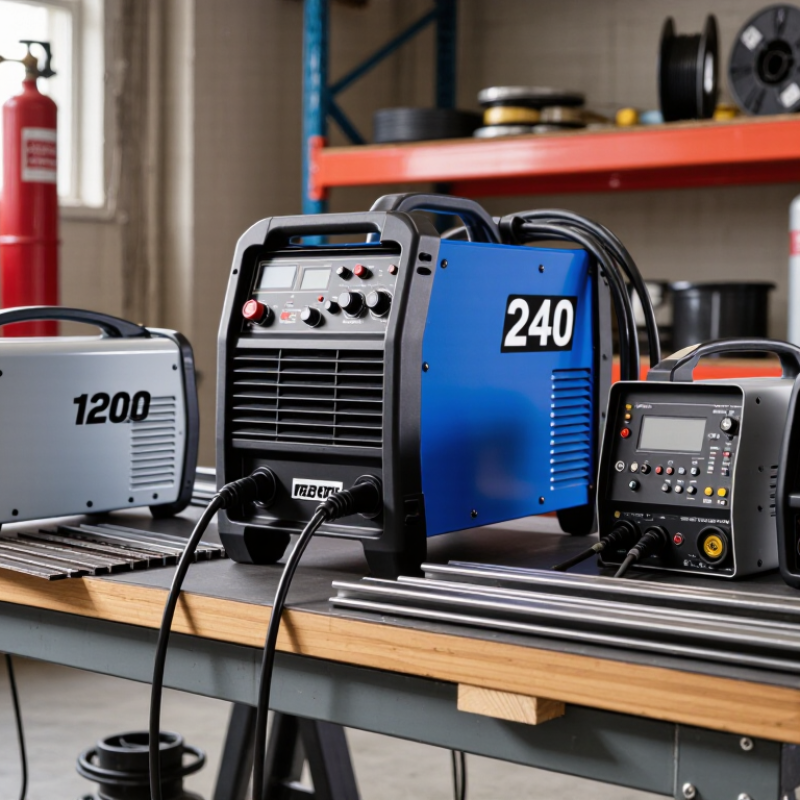
MIG welding, formally gas metal arc welding, feeds a continuous wire through a contact tip while shielding gas protects the molten pool. The wire serves as both electrode and filler metal. Operators mainly classify machines by power source, wire control, and arc-transfer mode. Transformer-based units are often heavier; inverter machines use electronic control and are typically more compact. A steady hum. On the shop floor, portability matters when the machine must move between benches.
A second distinction is control. Basic constant-voltage machines let welders adjust wire speed and voltage separately, while synergic models coordinate settings around material and wire choices. Arc modes include short-circuit transfer for thinner sections, spray transfer for higher deposition, and pulsed transfer for controlled heat input. Each has limits. Joint fit-up, gas selection, and operator technique still affect the bead. The label “MIG” is common, but active shielding gases technically make many applications MAG welding.
Market figures add context, not a ranking of machine types. Grand View Research estimated the global welding equipment market at about $15.1 billion in 2023, with projected annual growth of 5.3% from 2024 to 2030. That broad category includes more than MIG equipment, so it cannot show which MIG design performs best. For a small repair bench, a portable inverter may be practical; for repetitive production, duty cycle and wire-feed consistency deserve closer attention. A specification sheet helps, but real weld trials can expose what it misses.
Transformer MIG welders suit fabrication bays where machines run for long shifts and may face dust, vibration, and repeated high-current work. Their transformer-based power systems are typically heavier and mechanically straightforward, which can make them practical for fixed shop installations and repair teams familiar with conventional components. On the floor, that can mean a stable arc on thick steel, with less worry about moving a machine between jobs. They are not perfect. The weight, larger footprint, and lower portability matter in cramped workshops. Energy use and duty cycle also deserve checking against the actual job, not just the machine’s headline amperage.
Industry data shows why dependable equipment matters, though it does not prove one machine type is best. The American Welding Society’s workforce estimates project about 360,000 welding professionals will be needed in the United States by 2027. Grand View Research valued the global welding-equipment market at approximately USD 15.1 billion in 2023 and forecast continued growth through 2030. These figures point to sustained demand, not a guarantee of transformer-welder performance. Compare the rated duty cycle, input-power requirements, wire-feed consistency, and local repair support before buying. A transformer machine can be a workhorse. But an oversized, inefficient one can become an expensive bench ornament.
Inverter MIG welders replace bulky, low-frequency transformers with high-frequency switching electronics. The result is a lighter machine that is easier to move between a bench and a job site. Electronic controls can adjust voltage and wire-feed behavior quickly, helping maintain a steadier arc across thin sheet and thicker steel. Less bulk. More control.
The European Commission’s Ecodesign Regulation (EU) 2019/1784 sets a minimum power-source efficiency of 85% and an idle-state limit of 50 watts for covered welding equipment. These figures make efficiency more than a sales claim; buyers can check whether a machine meets defined requirements. Still, efficiency varies with operating conditions, and a compact case cannot compensate for an undersized duty cycle. Check the rating plate and manual.
At the torch, precise settings matter. Too much voltage can flatten the bead and increase spatter; too little may leave a tall, uneven weld. Digital displays help repeat settings, but they do not replace clean metal, correct wire speed, or a sound ground connection. In shop use, portability is useful. Yet fan noise and menus can feel distracting, and some settings take practice to understand. An inverter is capable, not automatic.
| Inverter MIG type | Typical input | Typical output class | Key characteristics | Common applications | Points to check |
|---|---|---|---|---|---|
| Compact single-phase inverter | Usually 120 V or 230 V, depending on model | Commonly about 100–200 A | Lightweight design; electronic control can provide a stable arc and adjustable settings in a small package. | Home workshops, light fabrication, and occasional repairs on thin-to-medium material. | Check the rated duty cycle, available circuit capacity, and whether the machine supports the desired wire and shielding gas. |
| Dual-voltage portable inverter | Typically 120/230 V; exact compatibility varies by model | Often about 140–250 A on 230 V; lower output is generally available on 120 V | Can connect to different supply voltages, offering flexibility for shop and field work. | Maintenance, mobile repairs, and work at sites with different power supplies. | Confirm the input plug, required circuit amperage, output limits at each voltage, and generator requirements if applicable. |
| Synergic inverter MIG | Usually single-phase; some higher-output models use three-phase power | Varies widely, commonly around 150–300 A | A selected wire, material, and gas program can coordinate wire-feed speed and voltage; manual adjustment is often available. | General fabrication and repeat jobs where simplified setup is useful. | Check which wire diameters, materials, gases, and process programs are supported; presets do not replace correct setup and technique. |
| Pulsed MIG inverter | Often 230 V single-phase or three-phase, depending on output class | Commonly about 200–400 A | Pulsed current helps control metal transfer and heat input; the process can reduce spatter in suitable applications. | Aluminum and stainless-steel fabrication, including work where heat control or weld appearance matters. | Requires compatible wire, gas, and settings. Compare pulse programs, duty cycle, and material-specific capability. |
| Industrial three-phase inverter MIG | Typically 400–480 V three-phase, with regional variations | Often about 300–500 A or more | Designed for higher output and sustained production; may include advanced process controls and separate wire feeders. | Production fabrication, heavy equipment, and thicker sections in properly specified setups. | Verify facility power, duty cycle at the intended current, cooling needs, feeder compatibility, and applicable safety requirements. |
Output figures are broad examples of common machine classes, not guaranteed specifications. Actual ranges, duty cycle, input requirements, and supported processes vary by model and operating conditions; consult the machine’s rated data plate and manual.
Multi-process MIG welders combine several welding modes in one machine, often including flux-cored, stick, and lift-TIG options. For a small workshop, that can mean fewer machines to move between a repair bench and a job site. A steel gate might call for MIG, while a thicker outdoor repair may suit flux-cored wire. Less equipment to juggle.
Synergic MIG welders simplify setup by matching wire-feed speed and voltage to selected wire, diameter, and material settings. The operator still chooses the right shielding gas and checks the manufacturer’s setup chart. On a thin sheet-metal panel, a controlled starting setting can help reduce burn-through. A test bead on scrap is still worthwhile. It reveals whether the arc sounds steady and the bead wets the edges evenly.
These machines are versatile, but their presets are not a substitute for judgment. Joint fit, torch angle, travel speed, and metal cleanliness all affect the result. A windy work area can also disrupt shielding gas and cause porosity. Small adjustments matter. Some interfaces feel crowded, and learning the menu can take longer than expected. Review the machine’s duty cycle and input-power requirements before buying; a broad feature list does not guarantee it suits every workshop.
Typical number of welding process families supported by each machine type
Synergic control automatically coordinates settings such as wire-feed speed and voltage; it does not add a welding process. Multi-process machines commonly combine MIG/MAG, stick (MMA), and DC TIG, but included processes vary by model. Counts show typical configurations, not a guarantee for every machine.
What Are the Top MIG Welding Machine Types in 2026?
Choosing a MIG Welder Type for Different Jobs in 2026
Choosing a MIG welder starts with the material, job size, and power available—not the biggest amperage number. For thin sheet metal, a compact inverter with stable low-current control can help prevent burn-through. Fit matters. Check the machine’s duty cycle, too; frequent pauses can slow longer repair or fabrication jobs.
Transformer machines are often heavier, but their straightforward controls suit fixed workshops and occasional repairs. Inverter models are lighter and usually offer finer adjustments, making them practical for mobile work or varied metal thicknesses. Some machines support both solid wire with shielding gas and flux-cored wire without external gas. That flexibility is useful, but switching processes does not automatically improve weld quality.
For aluminum, look for a setup compatible with a spool gun, which helps feed soft wire more consistently. For steel gates or farm repairs outdoors, flux-cored capability may be convenient when wind makes shielding gas difficult to manage. Not always. Compare the wire sizes, output range, input power, and torch connections before buying; these details affect whether a machine suits your actual jobs. A sensible choice can still disappoint if its settings are awkward or its duty cycle is too low, so review the manual and test on scrap metal before committing to a long weld.

