

LED strip lighting looks simple on a product page: a flexible tape, a roll length, and a wattage figure. Real projects are less tidy. Buyers must compare light output, color consistency, dimming behavior, thermal management, adhesive performance, and protection against dust or moisture. A bright sample is not enough. The same strip must perform consistently across every roll and reorder.
The U.S. Department of Energy’s 2020 U.S. Lighting Market Characterization found that LEDs represented roughly 48% of installed U.S. lighting stock. That figure is not specific to strips, and it does not describe every global market. Still, it shows how quickly LED technology has entered mainstream lighting. Lighting researcher Dr. Mariana Figueiro has described light as “a powerful drug,” underscoring that color and intensity can shape how a space feels and functions. That is worth considering when choosing accent, task, or display lighting. And buyers still miss it.
This Top 10 guide compares suppliers through practical criteria: product range, technical documentation, customization, quality control, and support after shipment. Certifications and warranties matter, but so do details on the bench: cut marks that align, stable color across a long run, and adhesive that holds on a clean surface. No ranking can replace testing a sample under real conditions. A small caveat. Supplier claims deserve verification, and product data can vary by model. Use this shortlist as a starting point for careful sourcing, not a substitute for checking the specification sheet and testing the finished installation.
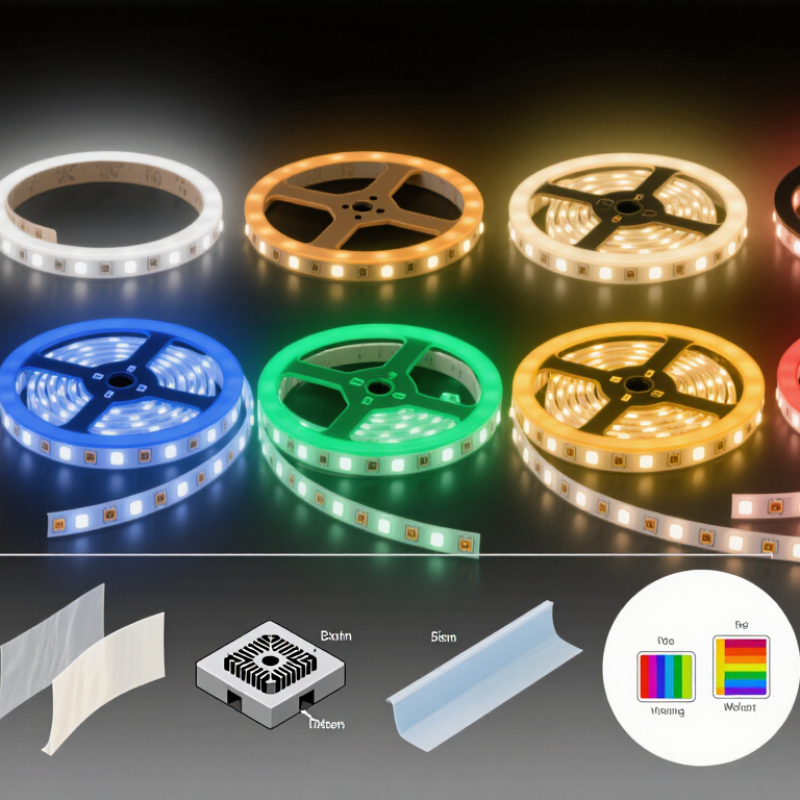
LED strip lighting uses flexible circuit boards carrying surface-mounted LEDs, usually powered by 12 V or 24 V DC. The voltage matters. At the same wattage, a 24 V strip draws half the current of a 12 V strip, which can reduce voltage drop across the same wiring. Long runs still need careful planning; wire size, strip power, and feed points all affect brightness. A dim tail is a common warning sign.
CCT describes how warm or cool white light appears, measured in kelvins. Lower values look warmer; higher values appear cooler. CRI estimates how faithfully a light source renders colors, on a scale up to 100. The CIE’s colour-rendering method uses eight test colors for its general CRI score, so that number does not tell the whole story about vivid reds. ENERGY STAR’s Lamps specification sets a CRI minimum of 80, a useful reference point rather than a guarantee for every strip. The U.S. Department of Energy reports that LEDs use at least 75% less energy than incandescent lighting, though that broad figure is not specific to strips. Check the actual strip, power supply, and diffuser together. The label alone can flatter reality.
For global buyers, compare LED strips by measured light output, not headline wattage. CRI 80+ suits corridors and utility areas; CRI 90+ can show skin, food, and fabric colors more naturally. Higher CRI may reduce efficacy, but not always—ask for test data for the complete strip. The U.S. Department of Energy’s 2022 Solid-State Lighting R&D Opportunities report sets a 250 lm/W LED-package efficacy target for 2035. That is a package target, not a guarantee of strip-level performance. Request lumens per watt at the specified color temperature, voltage, and operating conditions.
Binning affects whether adjacent strips look alike. Ask suppliers to state their color-bin range and, where consistency matters, the SDCM tolerance. A narrow tolerance helps limit visible color shifts across a long ceiling run. Small detail. Big difference. I would also check whether reported efficacy comes from an independent test report; supplier datasheets can omit heat, diffuser, and driver losses. Warranty length alone is incomplete. Confirm coverage, operating-hour assumptions, and the remedy for color shift or early failures.
Tips: Request a sample from the production bin, then compare it beside your chosen diffuser in the actual room. Photograph it under the intended lighting; memory is unreliable. Put CRI, efficacy, bin tolerance, and warranty terms in the purchase specification. One thing is easy to miss: a strong sample does not prove every production batch will match.
Global buyers should compare product ranges and delivery capability, not headline brightness alone. Established suppliers commonly offer single-colour, tunable-white, RGB, and RGBW strips, with different PCB widths, cut intervals, voltages, and ingress-protection ratings. For retail shelves, short cut intervals help reduce dark gaps. In damp locations, check the complete assembly’s protection rating, not just the coating on the tape. Details matter.
A broad catalogue is useful only when specifications stay consistent across batches. Compare lumen output per metre, colour-rendering index, colour-bin tolerance, dimming compatibility, and matched drivers. The International Energy Agency’s Energy Efficiency 2019 report estimated that lighting accounted for about 15% of global electricity use, making system efficiency a practical procurement concern. The U.S. Department of Energy reports that LEDs use at least 75% less energy and last up to 25 times longer than incandescent lighting. Those figures describe LEDs broadly, not every strip installation.
Global reach also means dependable regional stock, realistic lead times, export packaging, and accessible technical support. Ask suppliers for sample rolls and test them with the intended controller and driver; colour shifts can appear after dimming. Paper specifications are imperfect. A polished catalogue cannot reveal every batch variation, and buyers sometimes overlook that. Check warranty terms, replacement procedures, and traceability before placing a large order.
When comparing LED strip lighting suppliers, treat technical claims as evidence to verify, not sales language. Ask for test reports tied to the exact strip model, including revision, rated voltage, and production configuration. A certificate for a similar product may not cover the item you plan to install. Check the issuing laboratory and report date, too.
IP ratings follow IEC 60529, but the test conditions matter. IP65 indicates dust protection and resistance to water jets; IP67 covers temporary immersion under specified conditions. Neither rating automatically protects cut ends, connectors, or joints made on site. Ask how the complete assembly was tested. Small details matter.
LM-80 data measures lumen maintenance for LED packages, modules, or light engines under stated temperatures and drive currents. It is not a direct lifetime test of an entire strip. Request the underlying report, then check whether any projected life uses relevant operating conditions and a recognized method such as TM-21. Also compare those conditions with the strip’s heat management in your planned channel. A cool laboratory setup may not match a warm ceiling recess. Even careful checks leave gaps; inspect a sample and confirm the supplier’s documentation matches what arrives.
A supplier’s CCT claim should be backed by measured data, not a catalog label. Ask for the target CCT, chromaticity coordinates, and binning records for the actual strip. Three-step MacAdam SDCM limits visible color variation; it does not guarantee identical appearance across every reel. Small differences matter. Request samples from separate production batches and inspect them side by side on a neutral wall.
Check the test method and the product behind each document. LM-80 data measures LED package or module lumen maintenance, while TM-21 uses that data to project maintenance; neither alone proves whole-strip performance. Request photometric reports, electrical specifications, and applicable safety and EMC documents for the strip and its power supply. Confirm that reports identify the exact model and test conditions. U.S. Department of Energy guidance notes that LEDs use at least 75% less energy and can last up to 25 times longer than incandescent lighting, making verified performance worth checking.
For target-market compliance, request current test reports or certificates and verify their scope, model numbers, and issuing laboratory. Standards and required documents vary by destination. I would still test a pilot order: paperwork cannot reveal every color shift between reels, and that gap deserves attention. A short burn-in and a simple CCT comparison can catch problems before installation.
Anonymous, illustrative supplier-screening profiles—not verified claims about specific companies. Confirm product specifications, test reports, and market-specific requirements directly with each supplier.
| Profile | Typical Product Focus | Nominal CCT Options | SDCM Check | Electrical / Build Details to Verify | Compliance Documents to Request | Buyer Qualification Check |
|---|---|---|---|---|---|---|
| Supplier 1 | General-purpose indoor white strips | 2700 K, 3000 K, 4000 K, 5000 K, 6500 K | Request ≤3-step MacAdam ellipse data for each CCT and production bin | Confirm 12 V or 24 V DC, watts per metre, LED density, PCB width, and cut intervals | Applicable safety reports, RoHS/REACH declarations, and photometric data | Match sample CCT and measured output to the datasheet; confirm bin consistency across reels |
| Supplier 2 | High-density COB strips for continuous-looking light | 2700 K, 3000 K, 4000 K | Ask for SDCM ≤3 evidence and the measurement method used | Check input voltage, power per metre, bend direction, minimum bend radius, and maximum run length | Electrical safety documentation, RoHS/REACH declarations, and LM-79 or equivalent photometry where available | Inspect a lit sample for dark spots, colour uniformity, and adhesive performance on the intended surface |
| Supplier 3 | Tunable-white strips | Typical range: 2700–6500 K; confirm endpoints and intermediate settings | Request SDCM data at warm, neutral, and cool settings | Verify channel arrangement, controller compatibility, voltage drop, and power at both endpoints | Driver/controlgear safety documents, EMC evidence, RoHS/REACH declarations, and photometric files | Test colour transition, dimming range, and flicker with the proposed controller and driver |
| Supplier 4 | RGB and RGBW colour-changing strips | RGB/RGBW; white-channel CCT options vary by product | For RGBW white channels, request CCT bin and SDCM data; SDCM does not describe RGB colour accuracy by itself | Confirm channel order, common-anode/cathode type, voltage, controller protocol, and power per channel | Electrical safety and EMC documents for the strip and control system; market-specific substance declarations | Verify controller pinout, colour mixing, white-channel performance, and maximum current |
| Supplier 5 | Outdoor strips with protective coating or extrusion | 3000 K, 4000 K, 5000 K, and other stated options | Request ≤3-step SDCM report for the selected CCT and sealed configuration | Verify claimed IP rating under IEC 60529, connector sealing, operating temperature, and UV/weather suitability | IP test report for the exact assembly, electrical safety documents, RoHS/REACH declarations | Check whether the rating applies to the strip, end caps, connectors, and installed system—not just a component |
| Supplier 6 | High-output strips for coves and commercial interiors | 3000 K, 3500 K, 4000 K, 5000 K | Request ≤3-step SDCM data and colour-bin traceability by batch | Compare lumens per metre, watts per metre, thermal limits, PCB copper weight, and recommended heat sinking | Photometric report, safety documentation, EMC evidence where applicable, and material declarations | Run a thermal test in the actual channel/profile and check output and colour after warm-up |
| Supplier 7 | High-colour-rendering white strips | 2700 K, 3000 K, 3500 K, 4000 K | Request SDCM ≤3 data at the specified CCT; check batch-to-batch consistency | Verify CRI (Ra), R9, measured CCT, luminous output, and test conditions in the report | Full spectral or colour-rendering report, safety documents, and RoHS/REACH declarations | Request measured data rather than relying on an unsupported “high CRI” description |
| Supplier 8 | Low-voltage strips for cabinetry and furniture | 2700 K, 3000 K, 4000 K | Ask for CCT bin data and ≤3-step SDCM evidence for the chosen model | Confirm 12 V or 24 V DC, cut marks, connector type, polarity, and voltage drop over the planned run | Strip and power-supply safety documentation; RoHS/REACH declarations as applicable | Check fit in the channel, connector dimensions, dimmer compatibility, and installation instructions |
| Supplier 9 | Addressable or pixel-controlled strips | RGB; RGBW variants may offer a specified white CCT | For RGBW, request SDCM for the white channel; check RGB output separately | Verify IC type, data protocol, pixel length, refresh requirements, voltage, and power-injection guidance | Electrical safety and EMC evidence for the applicable system; material declarations | Test data direction, controller compatibility, signal integrity, and current draw at full output |
| Supplier 10 | Custom-cut or project-specific strip assemblies | Specify target CCT and tolerance in the purchase specification | Make ≤3-step SDCM, binning method, and batch records contractual requirements if needed | Document exact dimensions, voltage, wattage, connectors, lead wires, reel length, and approved substitutions | Reports and declarations for the exact finished configuration and destination market | Approve a pre-production sample and retain the signed specification, test reports, and change-control terms |
Compliance note: document requirements depend on product configuration and destination market. Verify the applicable standards and current legal requirements; a declaration or certificate for one component does not automatically cover the complete lighting system.

