

China has become a significant manufacturing base for Sport Smart Glasses, serving brands, distributors, and outdoor technology companies worldwide. Its supplier network includes optical laboratories, embedded-system developers, battery specialists, and precision assembly factories. This combination can support cycling, running, skiing, golf, and industrial training applications.
However, supplier lists require careful examination. A polished website proves very little. Buyers should request production samples, optical test reports, battery records, water-resistance results, and evidence of quality-control procedures. Comfort matters too. A frame that feels acceptable for five minutes may become painful after a two-hour ride. Lens fogging, weak sunlight visibility, unstable Bluetooth connections, and limited prescription support remain practical concerns.
Steve Mann, a pioneer in wearable computing, defined the field as “the study, design, construction, and use of miniature body-worn computational and sensory devices.” This principle remains relevant to Sport Smart Glasses. The technology should assist movement without distracting the wearer. Clear data, low-latency navigation, and reliable voice controls can be valuable on a windy mountain road. Excessive notifications cannot.
China’s leading manufacturers differ in engineering depth, customization ability, certification experience, and after-sales support. Some offer impressive prototypes but struggle with consistent mass production. Others provide dependable output yet limited innovation. That difference deserves attention. A trustworthy sourcing decision should combine factory audits, independent testing, transparent specifications, and real-world trials. The strongest supplier is not always the cheapest. It is the one that performs reliably when sunlight changes, sweat accumulates, and the user needs the display most.
China’s sport smart glasses manufacturing is moving from simple audio eyewear toward connected training equipment. Grand View Research valued the global smart glasses market at about USD 1.9 billion in 2023. It also forecasts strong growth through 2030. Counterpoint Research reported 62% year-on-year growth in global smart-glasses shipments during the first half of 2024. These figures suggest rising demand, but market definitions still vary.
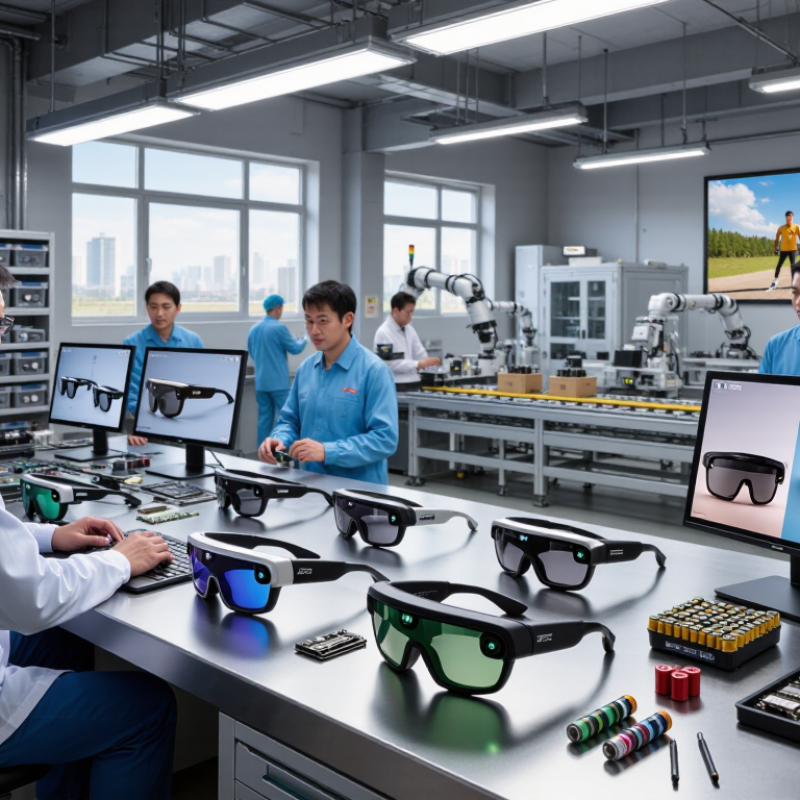
Chinese factories commonly integrate cameras, motion sensors, open-ear speakers, Bluetooth modules, and compact batteries. Sport-focused designs require careful balance. A frame should survive sweat, vibration, repeated bending, and sudden outdoor brightness. Production lines often use automated optical checks and several charging-cycle tests. Supplier audits should examine lens distortion, microphone clarity, heat control, and waterproofing records. Details matter.
Assembly is only part of the work. Engineering teams must tune software, sensor calibration, and mobile connectivity together. Some suppliers provide faster prototypes, while others offer stronger testing capacity. The cheapest quotation can hide weak traceability or inconsistent components. That is where buyers should slow down. Independent sample testing remains useful, especially for cycling, running, and training scenarios. A small weakness near the hinge may become a serious field failure. Public reports show growth, yet reliable sport performance still depends on factory discipline, not shipment numbers alone.
Sports smart glasses combine visual guidance, environmental sensing, and hands-free communication in a compact frame. In practical testing, a clear heads-up display matters more than decorative features. Riders need readable speed, distance, and navigation cues under bright sunlight. The display should not block traffic, teammates, or changing terrain.
Core technologies include GPS, motion sensors, gyroscopes, and optional heart-rate monitoring. These systems can record pace, elevation, direction, and movement patterns. However, heart-rate readings may weaken when sweat, vibration, or poor fit affects skin contact. That limitation deserves honest attention. Voice control is useful during training, while open-ear audio can preserve awareness of nearby sounds. Battery life should support a full session, not just a short demonstration. Weather resistance, lens durability, and stable wireless connections also influence reliability.
When evaluating Chinese manufacturers and suppliers, buyers should request test data, material specifications, and clear after-sales procedures. Ask how the glasses perform in heat, rain, and continuous movement. Field trials reveal problems that product sheets often hide. A frame may feel light at first, yet become uncomfortable after two hours. Charging ports, hinge strength, and app stability require repeated checks. Data protection also matters because sports glasses may collect location, biometric, and activity information. Good suppliers explain storage, permissions, updates, and repair options in precise language. Fancy specifications are not enough.
| Technology Dimension | Common Specification or Implementation | Sports-Oriented Function | Practical Considerations |
|---|---|---|---|
| Optical Display | Monocular or binocular near-eye display using waveguide, micro-OLED, or projection-based optical modules | Shows navigation prompts, workout metrics, alerts, and other information without requiring a phone check | Brightness, field of view, contrast, and outdoor readability vary significantly by optical architecture |
| Activity Sensors | Inertial measurement unit with accelerometer and gyroscope; some designs also include a magnetometer | Tracks head movement, orientation, motion patterns, and interaction gestures | Sensor data alone does not provide clinical-grade health measurements and may require software calibration |
| Positioning and Navigation | Location data generally supplied by a paired smartphone; some advanced systems may integrate positioning hardware | Supports route guidance, distance awareness, and location-based activity information | Accuracy depends on the phone, satellite visibility, mapping service, and surrounding environment |
| Camera and Video | Optional forward-facing camera for still images, video recording, or visual recognition | Captures hands-free training footage, outdoor scenery, and point-of-view sports content | Image quality is affected by lens size, stabilization, lighting, storage, and local recording regulations |
| Audio System | Open-ear speakers, directional audio modules, or bone-conduction components with one or more microphones | Delivers navigation instructions, calls, coaching prompts, and media while keeping the ears relatively open | Wind noise, traffic, fit, and volume levels influence speech clarity and situational awareness |
| Wireless Connectivity | Bluetooth is commonly used for phone pairing, audio, controls, and application synchronization; Wi-Fi may be included for data transfer | Enables smartphone notifications, firmware updates, cloud synchronization, and connected coaching services | Actual range and reliability depend on the wireless standard, antenna design, phone compatibility, and interference |
| Voice and Touch Controls | Physical buttons, capacitive touch areas, wake-word detection, or microphone-based voice commands | Allows hands-free control of audio, calls, camera functions, and selected workout information | Voice performance can decrease in wind, crowds, rain, or other high-noise environments |
| Battery and Charging | Rechargeable lithium-based battery with magnetic, USB, or case-based charging; operating time varies by feature usage | Provides power for audio, sensors, wireless communication, displays, and recording during training sessions | Continuous video, bright displays, calls, and wireless streaming generally reduce runtime substantially |
| Weather Resistance | Selected models use an ingress-protection rating such as IPX4 or higher, depending on product design | Improves suitability for sweat, light rain, and outdoor exercise | An IP rating does not automatically mean protection against swimming, high-pressure water, saltwater, or dust unless specifically stated |
| Lens and Vision Options | UV-filtering, tinted, photochromic, polarized, interchangeable, or prescription-compatible lenses may be available | Supports visual comfort and clearer viewing across cycling, running, hiking, and other outdoor activities | Polarized lenses can affect the visibility of some electronic displays; prescription compatibility must be confirmed before purchase |
| Ergonomics and Fit | Lightweight frame construction, adjustable nose pads, flexible temples, and secure sport-oriented retention features | Reduces movement and discomfort during running, cycling, fitness training, and extended wear | Balance, temple pressure, lens fogging, helmet compatibility, and sweat management should be evaluated in real use |
| Health and Performance Data | May display data received from connected watches, bike computers, heart-rate sensors, or fitness applications | Provides quick access to pace, heart rate, cadence, distance, time, or other compatible metrics | The glasses may act primarily as a display or control interface; measurement accuracy usually comes from the connected sensor |
| Safety and Privacy | Recording indicators, privacy controls, permission management, and user-selectable data-sharing settings | Helps users manage recording, notifications, and personal data during public or group activities | Users should follow local laws, venue rules, traffic regulations, and consent requirements when recording others |
| Software and Compatibility | Companion mobile application with firmware updates, device settings, activity synchronization, and account management | Adds configurable controls, performance summaries, navigation support, and integration with selected services | Supported operating systems, application permissions, language support, and update policy should be checked before deployment |
| Manufacturing and Customization Factors | Common customization areas include frame color, lens type, prescription support, logo placement, packaging, firmware language, and accessory configuration | Allows sports smart glasses to be adapted for retail programs, team use, promotional projects, or specialized outdoor applications | Minimum order quantity, optical certification, wireless compliance, tooling, software localization, and quality-control requirements affect lead time and cost |
Note: Specifications and functions vary by product configuration. The information above describes common technologies and purchasing considerations in the sports smart glasses industry rather than the specifications of any particular company or brand.
China’s sport smart glasses market includes several supplier categories, each serving a different purchasing need. OEM manufacturers build products from a buyer’s drawings, materials, and technical specifications. ODM suppliers offer tested frame designs that can be adjusted for size, color, lenses, and control features. This option usually shortens development time. Specialized optical factories focus on impact-resistant lenses, anti-fog coatings, UV protection, and prescription compatibility. Their experience matters during cycling, running, and outdoor training.
Electronic assembly suppliers handle microphones, speakers, batteries, sensors, and wireless modules. Reliable factories should provide battery cycle reports, waterproof testing records, and production samples before mass manufacturing. Ask for frame stress tests too. A comfortable hinge can fail after repeated use. Not every supplier manages optical and electronic quality equally well. This is easy to overlook.
A capable full-service manufacturer may coordinate molding, lens installation, firmware testing, packaging, and shipment. Supplier categories also include private-label partners, component vendors, and inspection companies. Buyers should compare minimum order quantities, tooling costs, lead times, and after-sales procedures. Factory audits can verify equipment, worker training, traceability, and quality-control records. Photographs are not enough. I have found that clear documentation often predicts smoother cooperation than a low quotation. Still, inspections cannot reveal every future problem, so pilot orders remain important. Fitness users notice pressure points, audio leakage, and battery weakness quickly. Test the glasses in real movement, not only on a clean showroom table.
How to Evaluate Chinese Sport Smart Glasses Suppliers
China’s sport smart glasses sector combines optical hardware, sensors, audio, and mobile software. Grand View Research estimated the global smart glasses market at about USD 1.6 billion in 2023, with strong growth expected through 2030. That growth attracts capable factories, but also inexperienced trading companies. Request a factory address, business license, production photos, and a recent audit report. Video calls help, but they do not replace an on-site inspection.
Test working samples under realistic conditions. Run for 60 minutes during cycling, running, and outdoor walking. Check lens clarity, microphone performance, sweat resistance, charging stability, and Bluetooth reconnection. The IP rating should match your product claims; ask for laboratory evidence, not a printed logo. IEC 60529 defines the common IP testing framework. Battery data should include capacity, charging cycles, and operating time with audio and sensors active.
Ask how suppliers manage optical alignment, firmware updates, defective units, and spare parts. A supplier promising every feature immediately deserves caution. It may indicate weak engineering control. Request the bill of materials and a pilot order before large production. Counterpoint Research has reported rapid growth in smart-glasses shipments, yet shipment growth does not prove sports reliability. I would also compare three samples from different batches. Small differences matter. Suppliers sometimes provide their best sample first. That detail is easy to miss.
China’s sport smart glasses manufacturers support OEM projects from early sketches to export-ready production. Experienced teams review frame geometry, lens clarity, weight balance, and control placement for active users. A practical prototype should survive repeated sweat exposure, outdoor glare, and sudden temperature changes. Comfort matters during long rides. It cannot be judged from drawings alone.
Customization may include color, logo placement, lens options, packaging, firmware settings, and accessory selection. Suppliers usually provide samples before mass production. Buyers should test those samples during real movement, not only on a showroom table. Some prototypes look impressive but feel unstable after thirty minutes. That weakness deserves honest correction.
Reliable quality control covers incoming materials, assembly accuracy, charging performance, optical inspection, and final function testing. Production records should identify batch numbers and inspection results. Export service may include commercial invoices, packing lists, product specifications, shipping coordination, and destination requirements. Clear communication reduces costly surprises. Still, no supplier should promise zero defects. Even strong processes need random checks, corrective actions, and occasional redesigns when field feedback reveals a problem.
This chart presents a practical sourcing-weight model for evaluating China-based smart glasses manufacturers and suppliers. Product quality, OEM customization, quality control, export capability, and after-sales support are commonly used dimensions when comparing suppliers without relying on company or brand data.

