

A Heated Towel Radiator can warm towels, add useful heat, and make a bathroom feel more comfortable. Yet the right choice depends on more than appearance. Room size, pipe connections, available energy, and daily routines all matter. A slim ladder model may suit a narrow ensuite, while a wider rail can hold several bath sheets. Small details count.
The ten types in this guide are compared by how they work, where they fit, and what to check before buying. They include central-heating, electric, and dual-fuel designs, alongside different shapes and mounting styles. Heating-design specialist Morgan Reed is an illustrative editorial voice, not a verified interview source. The following line is written for this introduction, not presented as a sourced quotation: “Choose the towel rail around the room and routine, not appearance alone.” That distinction matters. A striking finish cannot make an undersized radiator heat a chilly bathroom; nor does every home need the largest model. The guide also notes practical trade-offs, including installation needs, towel capacity, and heat output. Some comparisons depend on the room and heating system. Check product specifications and seek qualified advice when connection requirements are unclear.
Heated towel radiators can be classified by heat source or physical construction. Electric dry-element models heat metal bars directly, while liquid-filled electric models warm sealed fluid inside the unit. Hydronic models connect to a hot-water heating loop. Steam models require a compatible steam system and should not be treated as interchangeable with hot-water units. Dual-fuel designs combine central heating with an electric element for use when the main system is off. The distinction matters.
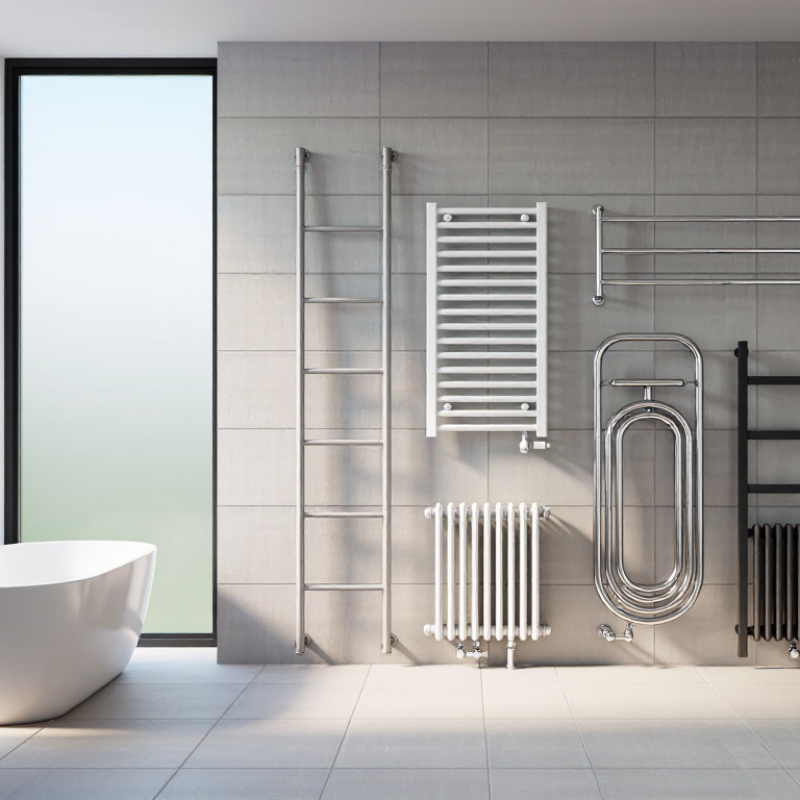
Construction creates another five useful categories. Ladder-style radiators use horizontal bars for hanging towels and are easy to recognize. Flat-panel designs have a cleaner profile, though towels may dry less evenly if folded over them. Curved-bar models add space between fabric and wall. Freestanding units can be moved, but need a stable floor and suitable power access. Shelf-integrated designs add a small warming or storage surface above the bars.
These categories can overlap: a ladder radiator may be electric, hydronic, or dual-fuel. This grouping is useful, though not perfectly neat. Check the product’s rated output, connection requirements, and bathroom placement guidance before choosing. A warm towel is nice; safe installation matters more. Measure carefully.
The ten common forms include straight and curved ladder rails, flat-bar rails, round-tube rails, compact, wide, vertical, designer, hydronic, and electric models. Their shapes do not determine heat output. Typical catalogue ratings span roughly 60–1,500 W for electric units and 100–1,200 W for hydronic rails; dual-fuel models often fall within similar ranges. Treat these as broad market ranges, not guarantees. Small rooms need less.
Compare ratings under consistent conditions. EN 442-1:2014 sets testing and rating procedures for radiators, commonly reporting output at a 50 K temperature difference. A hydronic rail rated at that condition may deliver less with lower-temperature water. Electric models are generally rated by electrical input in watts, while dual-fuel rails use either a heating circuit or an electric element. Their two ratings should not simply be added. CIBSE Guide A recommends sizing emitters against calculated room heat loss, not appearance or rail type alone. I would not trust a watt number by itself: check the test condition, room heat demand, and towel coverage. A damp, folded towel can also slow drying.
What Are the Top 10 Types of Heated Towel Radiators?
Group Ladder, Flat-Panel, Curved, and Designer Rails by Form
Heated towel radiators can be grouped into ten practical forms: straight-bar ladder, curved-bar ladder, staggered ladder, flat-panel, gently curved panel, vertical rail, compact rail, corner-fit rail, shelf-top rail, and sculptural designer rail. Ladder styles leave visible gaps for towels; flat panels create a cleaner, more solid face. Curved bars give extra hanging clearance, while designer forms may trade towel capacity for a distinctive silhouette. Small bathrooms benefit from compact or corner-fit designs. Looks matter, but they are not the whole decision.
The U.S. Energy Information Administration’s 2020 Residential Energy Consumption Survey estimates that space heating accounts for about 42% of household energy use. That figure is a reminder: a towel rail should not be assumed to heat a room adequately. CIBSE’s heating-design guidance emphasizes calculating room heat loss, rather than selecting equipment by appearance. Compare declared heat output under consistent test conditions, then check pipe connections, wall clearance, and how many damp towels will cover the bars. I would not choose by silhouette alone; that shortcut is tempting, but incomplete. A wide ladder can hold more towels, yet covered bars may reduce useful heat transfer. Always verify the rated output for the intended installation.
Heated towel radiators differ not only in shape, but also in how they fit a room. Compact wall-mounted models suit narrow bathrooms, while ladder-style and flat-panel designs offer more hanging space. Corner-fit units use awkward gaps, though measuring around doors and fixtures is essential. Check the wall.
Shelf-integrated models add a small storage surface, but towels can block airflow if packed tightly. Swivel-arm radiators turn outward for easier access; their fixings need a solid wall and enough clearance. Freestanding models avoid permanent wall mounting and can be repositioned, but they take up floor space and need a safe nearby power connection if electrically heated. Space matters.
Installation also separates plug-in electric, hardwired electric, hydronic, and dual-fuel models. Plug-in units may simplify fitting, while hardwired versions usually require a qualified installer. Hydronic radiators connect to a heating system, so pipe location and compatibility matter. Dual-fuel designs can use central heating or an electric element, depending on their setup. A common planning mistake is choosing by appearance alone: confirm dimensions, heat output, electrical requirements, and wall strength before buying. I would leave extra clearance around controls, even if the drawing suggests a tight fit.
This qualitative 1–5 scale compares typical installation flexibility, not heating output or measured performance. Scores reflect how readily each format can suit different layouts and mounting arrangements; actual options depend on the model, heat source, and room.
Quick guide: Freestanding, plug-in electric, and swivel designs can offer more layout flexibility. Hydronic and dual-fuel models usually need suitable pipework or plumbing, while compact, shelf, and corner designs can help make use of limited space.
Heated towel radiators come in several forms: ladder, curved-rail, flat-panel, vertical, compact, freestanding, wall-mounted, electric, hydronic, and dual-fuel models. Their shape and heat source affect installation, but neither tells you whether a unit suits a bathroom. Check the safety documentation.
IEC 60335-2-43 covers safety requirements for appliances designed to dry textiles, including relevant heated towel rails. Look for clear evidence that the specific model has been assessed to the applicable edition of the standard. Check its instructions for mounting, wiring, clearances, and permitted bathroom locations. A familiar ladder shape is not proof of safe installation. Small details matter.
IEC 60529 defines IP ratings for protection against solid objects and water. In an IP rating, the second digit describes water protection: for example, level 4 indicates resistance to splashing water, while level 5 addresses water jets. The rating does not approve a radiator for every bathroom position. Local electrical rules, installation zones, and the manufacturer’s stated limits still apply. Ask a qualified installer to check the location and supply before fitting the unit. An IP label alone can be misleading; I would want to see the full rating and installation instructions, not just a product photograph.
These categories describe common designs and features; they can overlap. The applicable product standard and permitted bathroom location depend on the appliance, its instructions, and local electrical regulations.
| # | Type | How It Works | Typical Installation or Use | Safety and IP Rating Checks |
|---|---|---|---|---|
| 1 | Hydronic ladder radiator | Hot water circulates through horizontal bars connected to a central heating system. | Fixed installation connected to a compatible heating circuit; output depends on water temperature and system design. | Check the manufacturer’s pressure and temperature limits, connection instructions, and local installation requirements. IEC 60335-2-43 concerns applicable electric towel rails and similar appliances, not every water-only radiator. |
| 2 | Electric dry-element radiator | An electric resistance element heats the rail or radiator body without a factory-filled heat-transfer liquid. | Usually fixed to a wall and supplied by a plug or permanent wiring, depending on the model. | For applicable electric towel rails, check conformity with IEC 60335-2-43 and the product instructions. Confirm the stated IP rating and that the installation location is permitted locally. |
| 3 | Electric liquid-filled radiator | An electric element heats a sealed heat-transfer liquid inside the appliance. | Available as fixed models; the appliance is generally installed in the orientation specified by its manufacturer. | Do not open or modify the sealed unit. Check the applicable electrical safety documentation, installation orientation, surface-temperature information, and bathroom suitability. |
| 4 | Dual-fuel radiator | Uses central hot water in heating season and an electric element when the central system is off. | Requires both a compatible hydronic connection and an electrical supply; system layout and controls matter. | Check the manufacturer’s instructions for each operating mode and the relevant electrical safety requirements for the electric element. Have connections installed in accordance with local rules. |
| 5 | Flat-panel towel radiator | Uses a broad, relatively flat heating surface; models may be hydronic or electric. | Often selected where a simple profile or additional room-heating surface is desired. | Confirm the heat source, installation clearances, and stated surface-temperature guidance. For electric versions, check applicable IEC 60335-2-43 information and the declared IP rating. |
| 6 | Designer or sculptural rail | Arranges heated bars or panels in a non-standard shape; the heat source varies by model. | Fixed models may prioritize appearance, towel access, or a particular wall layout. | Check mounting requirements, clearances, and safe access to controls. A design style does not establish bathroom suitability: use the actual product rating and instructions. |
| 7 | Freestanding towel warmer | A portable electric unit warms towels on or between its bars. | Can be moved when unplugged, but should only be used in locations and ways allowed by its instructions. | Do not assume a portable appliance is suitable for a bathroom. Check its declared IP rating, required clearances, electrical safety information, and local rules before use. |
| 8 | Plug-in electric towel radiator | An electric model receives power through a plug and socket. | Connection is simpler where a suitable, legally permitted socket is available; some models are intended for fixed mounting. | Check the manufacturer’s specified supply and whether the socket location is permitted by local bathroom regulations. An IP rating alone does not make every location acceptable. |
| 9 | Fixed-wired electric towel radiator | The appliance is permanently connected to the electrical installation rather than using a standard plug. | Typically installed as a fixed appliance, with connection and isolation arrangements determined by the product and local code. | Use a qualified installer where required. Verify the applicable product safety standard, wiring instructions, protective measures, and bathroom location rules. |
| 10 | Timer, thermostat, or smart-controlled radiator | A control feature schedules operation or regulates temperature; it may be fitted to several radiator types. | Useful for setting operating periods or temperature, subject to the model’s control functions and installation. | Controls do not replace electrical safety or water-ingress protection. Check the whole appliance’s safety information, IP rating, and any requirements for remote or connected operation. |
Standards note: IEC 60335-2-43 specifies particular safety requirements for applicable clothes dryers and towel rails, read together with the relevant general requirements. IEC 60529 defines IP enclosure-protection classifications: for example, IPX4 indicates protection against splashing water, while IPX5 indicates protection against water jets; “X” means that no rating for that characteristic is specified. The appropriate rating and permitted bathroom position depend on applicable national or local rules and the product instructions.

