

China Top 10 Industrial Cable Manufacturers for Global Buyers

Choosing a cable supplier is not a catalog exercise. A factory floor may need flexible control cables beside moving machinery, while a port project may require heavy-duty power cables built for outdoor exposure. The right choice depends on operating conditions, voltage, conductor material, insulation, testing, and delivery needs.

Michael Faraday, a foundational authority in electrical science, is often quoted as saying, “Nothing is too wonderful to be true, if it be consistent with the laws of nature.” That principle fits cable selection: impressive claims matter less than designs supported by engineering data and consistent test results. Details matter.

This guide introduces 10 Chinese Industrial Cables manufacturers for global buyers. It considers product range, production capability, quality systems, export experience, and the clarity of technical documentation. Buyers should check specifications against their own project requirements, including applicable IEC or other relevant standards, conductor size, insulation type, temperature rating, and test reports. A polished website is not proof of suitability.

No list can replace supplier due diligence. Even a capable manufacturer may not fit every application, and available information can change. Ask for current certificates, sample reports, and clear answers about customization and lead times. Small gaps in documentation deserve attention. They may be harmless—or they may signal a question worth asking.
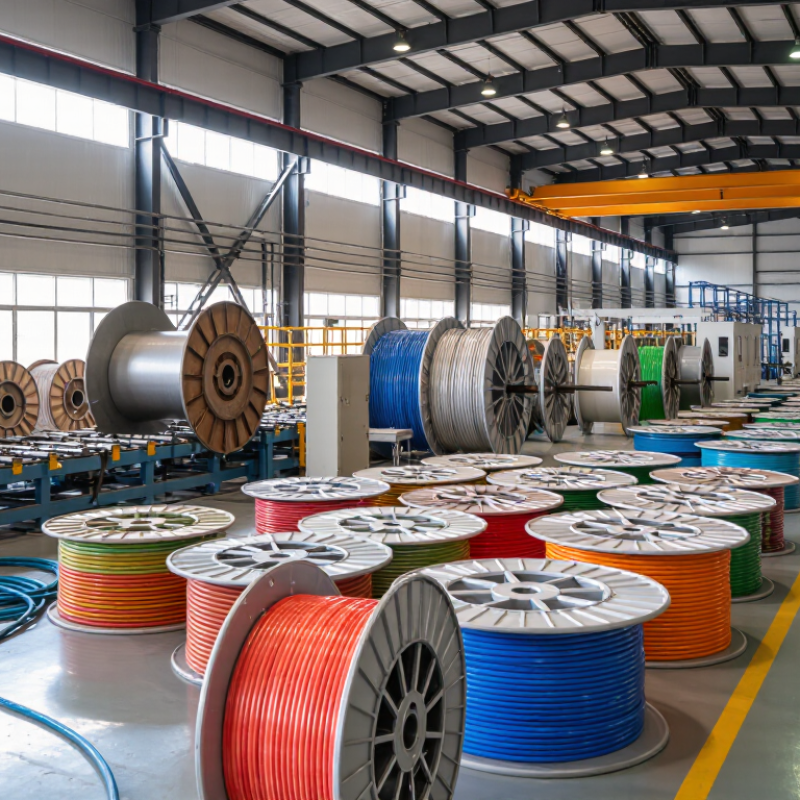
China Top 10 Industrial Cable Manufacturers for Global Buyers

Overview of China’s Industrial Cable Manufacturing Industry

China’s industrial cable sector serves power generation, factories, transport systems, and construction projects. Its manufacturing base benefits from a large domestic infrastructure market, but public statistics do not consistently separate industrial cables from other wire and cable products. The picture is not perfectly tidy.

The China Electricity Council reported that national power-grid investment reached about RMB 527.5 billion in 2023. This figure signals substantial demand for grid equipment, including cables, but it is not a measure of cable sales. The National Bureau of Statistics also reported that China’s manufacturing value added grew 5.0% in 2023. That broader trend helps explain the need for reliable connections across expanding production lines.

For buyers, product suitability matters more than a headline capacity claim. A cable routed beside a hot motor needs different insulation from one installed in a control cabinet. Check conductor material, voltage rating, temperature range, shielding, and documented test results. Ask for traceable batch records, too. Details matter. The International Energy Agency’s Electricity Grids and Secure Energy Transitions report highlights the global need for stronger grid investment, while reminding readers that cable demand depends on actual projects. China offers a deep supplier base, yet specifications and quality evidence still require careful review.

Criteria for Selecting Leading Chinese Cable Manufacturers

Choosing a Chinese industrial cable manufacturer requires more than comparing unit prices. The International Energy Agency’s 2023 report, Grids and Secure Energy Transitions, says over 80 million kilometres of grids must be added or refurbished by 2040. It also estimates annual grid investment must exceed US$600 billion by 2030. For buyers, this points to a practical priority: verify whether production capacity, delivery schedules, and quality controls can support long-term projects, not just a sample order.

Check technical evidence against the cable’s intended use. Review conductor resistance, insulation thickness, voltage rating, and test records, and compare them with relevant IEC requirements, such as IEC 60228 for conductors. Ask for batch traceability and recent third-party test reports. Look closely. A certificate alone does not prove that every production lot meets specification. Factory audits can help assess equipment maintenance, calibration practices, and how defects are handled. Still, a polished audit visit may not reveal routine weaknesses; request dated records and consistent production data.

Assess communication and commercial reliability as carefully as engineering. Confirm how the supplier manages design changes, nonconforming products, packaging, and shipment delays. Request clear answers in writing, especially for custom specifications. A low quotation may exclude testing, documentation, or protective packaging. That is easy to miss. Compare quotations on the same technical basis, then weigh documented performance against price. No checklist removes all risk, but verifiable evidence makes supplier comparisons more dependable.

Profiles of 10 Industrial Cable Manufacturers in China

China’s industrial cable sector is best understood through manufacturing specialisms, not a single ranking. The ten profiles cover high-voltage power, low-voltage distribution, control, instrumentation, mining, marine, flexible automation, fire-performance, renewable-energy, and custom-assembly manufacturers. Different jobs demand different constructions. Mining cables need abrasion resistance and reliable flexing; instrumentation cables need shielding and stable signal transmission. The IEA’s 2023 report, Electricity Grids and Secure Energy Transitions, estimates that about 80 million kilometres of grids must be added or refurbished by 2040. That scale makes verified production capacity more meaningful than a low quoted price.

Useful profiles document conductor material, voltage rating, insulation, operating temperature, and application limits. They also distinguish in-house testing from independent certification. Ask for sample test reports and check whether the stated cable construction matches the intended installation. A catalog is not proof. Factory audits can reveal practical details, such as how batches are traced or how finished reels are protected from moisture. I would treat polished datasheets cautiously; specifications can look complete while leaving test conditions unclear. These ten capability-based profiles give buyers a grounded way to compare Chinese manufacturers without treating unlike products as interchangeable.

China’s Industrial Cable Manufacturers: Common Conductor Sizes

A reference chart of common nominal conductor cross-sectional areas used in industrial cable specifications. It contains no company or brand data.

Reference: common nominal conductor cross-sectional areas specified in IEC 60228. The suitable conductor size depends on current, installation conditions, and cable design.

Key Cable Products and Their Industrial Applications

China Top 10 Industrial Cable Manufacturers for Global Buyers

Key Cable Products and Their Industrial Applications

Industrial cable selection starts with the working environment, not just the conductor material. Power cables carry electricity to motors, pumps, and production lines. In a factory, insulation must tolerate heat, oil, abrasion, or repeated bending as needed. Heat matters. A cable routed beside a hot furnace needs different protection from one installed inside a control cabinet.

Control and instrumentation cables transmit signals between sensors, controllers, and monitoring equipment. Shielding can help reduce electrical interference near variable-speed drives. For moving machinery, flexible cables are often used in drag chains, where repeated motion can strain conductors and jackets. Check the bend radius and expected travel distance. Small details matter.

Specialist options include fire-resistant cables for maintaining selected circuits during emergencies, and mining cables designed for rough, mobile environments. Solar installations commonly use cables made for outdoor exposure and changing temperatures. Product names alone are not enough. Buyers should compare voltage rating, temperature range, conductor size, sheath material, and relevant test documentation. Specifications can look reassuring, yet site conditions are easy to underestimate. A careful review with the installer or engineer can prevent a poor fit.

China Top 10 Industrial Cable Manufacturers for Global Buyers - Key Cable Products and Their Industrial Applications

A practical comparison of ten common industrial cable product categories. Entries are product profiles, not a ranked list of companies; no manufacturer or brand names are shown. Construction and ratings vary by design and project specification.

No. Cable Product Typical Construction or Rating Key Features Typical Industrial Applications Buyer Specification Checks
1 Low-Voltage Power Cable Copper or aluminum conductors; common insulation and sheath options include PVC and XLPE; typically rated up to 1 kV. Available in single-core or multicore designs, with optional armour for mechanical protection. Factory distribution, building services, pumps, motors, and general low-voltage equipment. Conductor material and size, rated voltage, installation environment, temperature rating, and applicable test standard.
2 Medium-Voltage Power Cable Usually screened single-core or three-core construction with XLPE insulation; designs commonly cover rated voltages from 6 kV upward. Semiconductive conductor and insulation screens help manage the electric field; armour may be specified for certain installations. Industrial substations, utility distribution, large motors, and power supply to processing plants. System voltage, conductor size, screen design, short-circuit duty, installation method, and relevant standard.
3 Control Cable Multicore copper cable, commonly with PVC or XLPE insulation and an overall sheath; screened versions are available. Designed to carry control and interlock signals between equipment and control panels. Production lines, switchgear, machine controls, HVAC systems, and equipment interconnections. Core count, conductor cross-section, flexibility, screening, oil or chemical exposure, and required flame performance.
4 Instrumentation Cable Typically twisted pairs or triads with individually and/or collectively screened conductors. Screening helps reduce electromagnetic interference in low-level signal circuits. Process measurement and control in chemical plants, refineries, water treatment facilities, and power stations. Pair or triad count, screen arrangement, capacitance, operating temperature, hazardous-area requirements, and signal type.
5 Variable-Frequency Drive Cable Power conductors with symmetrical grounding conductors and a robust overall screen; insulation and sheath depend on the installation. Screening and grounding design help manage electromagnetic interference from inverter-driven motor systems. Connections between variable-frequency drives and motors in pumps, fans, conveyors, and compressors. Drive and motor requirements, voltage, screen coverage, grounding arrangement, cable length, and bending conditions.
6 Thermocouple Extension or Compensating Cable Conductors selected to match or compensate for a specified thermocouple type; commonly supplied as pairs with optional screening. Maintains the intended thermoelectric signal connection when installed with the correct polarity and cable type. Temperature measurement in furnaces, kilns, process lines, and industrial instrumentation systems. Thermocouple type, extension versus compensating grade, polarity identification, temperature range, and screen requirements.
7 Industrial Fiber-Optic Cable Single-mode or multimode optical fibers in a protective construction; indoor, outdoor, and armored designs are available. Supports high-bandwidth data links and is not affected by electromagnetic interference in the same way as copper signal cables. Industrial Ethernet backbones, plant networks, control-system links, and communications between buildings. Fiber type, fiber count, connector compatibility, indoor or outdoor use, bend limits, and mechanical protection.
8 Marine and Offshore Cable Power, control, or instrumentation designs with insulation and sheathing selected for marine service; fire-resistant options may be specified. May be designed for exposure to moisture, salt-laden air, vibration, and limited installation space. Ships, offshore platforms, port equipment, and marine power and control systems. Applicable marine approval, fire performance, smoke and halogen requirements, voltage, oil resistance, and installation location.
9 Mining Trailing Cable Heavy-duty flexible power cable, often with rubber-based insulation or sheathing and protective conductor arrangements. Designed for repeated movement and demanding mechanical conditions; exact construction depends on mining equipment and site rules. Mobile mining machinery, underground equipment, and movable power supplies at mining sites. Equipment voltage, conductor arrangement, flexibility, abrasion and impact exposure, flame requirements, and local regulations.
10 Crane and Reeling Cable Flexible power or control cable designed for moving equipment; flat or round constructions and reinforced options are available. Selected for repeated flexing, travel, and, where applicable, winding onto a reel or festoon system. Overhead cranes, port machinery, hoists, automated storage systems, and moving industrial equipment. Travel speed and distance, bending radius, tensile load, torsion, conductor size, and compatibility with the handling system.

How Global Buyers Evaluate and Source from Chinese Manufacturers

Buying industrial cable from China starts with a clear application, not a supplier list. Define voltage, conductor material, insulation, operating temperature, installation conditions, and expected service life. A cable suited to a dry indoor tray may perform poorly in heat, oil, or repeated movement. Small details matter. Request a datasheet and compare its values with your project specification. Ask how the factory checks conductor dimensions, insulation thickness, and finished-cable performance. Test methods and records should relate to the production lot being quoted. A polished catalog is not proof.

Before ordering in volume, check production capacity, lead times, packaging, and the supplier’s process for handling defects. Request a sample reel, then inspect its labeling, construction, and dimensions against the agreed specification. If possible, arrange independent testing for critical applications. A sample can still differ from later production, so confirm that the approved design and materials will be used consistently. This step can take time, but it is cheaper than discovering a mismatch after delivery.

Communication is part of supplier evaluation. Send the same technical questions to each candidate and compare how clearly they answer, especially when a requirement is uncertain. Confirm the quotation’s included tests, documentation, delivery terms, and packaging details in writing. Buyers may focus heavily on price; that is understandable, but it can hide differences in testing scope or material quality. Even a careful process cannot remove every risk. It can make problems easier to spot before the cable reaches the job site.