Top 10 Folding Mesh Door Manufacturers Worldwide?
The global Folding Mesh Door market is gaining attention as homes, restaurants, warehouses, and commercial entrances seek flexible ventilation and insect control. Demand is supported by renovation activity, denser urban housing, and wider adoption of space-saving door systems. Grand View Research identifies continued growth in the global doors market, while The Freedonia Group’s World Windows & Doors analysis highlights replacement demand, energy performance, and design flexibility as important purchasing factors. These reports do not isolate every Folding Mesh Door category, so rankings require careful interpretation.
Building-science expert Joseph Lstiburek offers a practical principle: “Buildings are simple. They keep the weather out and let people in and out.” That idea fits a folding mesh system. A well-made door should glide smoothly, close evenly, and resist sagging after repeated use. Look closely at mesh density, frame rigidity, track design, magnets, hinge durability, and repair support. Small details matter. A loose bottom seal can invite insects. Weak rollers can create a rough, noisy movement.
This guide reviews ten manufacturers worldwide, comparing product quality, manufacturing scale, customization, certifications, warranty terms, and distributor support. It also considers real installation conditions, including balconies, patio openings, restaurant service areas, and industrial entrances. Not every manufacturer publishes comparable data. That is a limitation worth admitting. Prices can change by region, material, order volume, and installation complexity. Buyers should verify technical claims directly, request samples, and test the door in its intended opening before making a final decision.
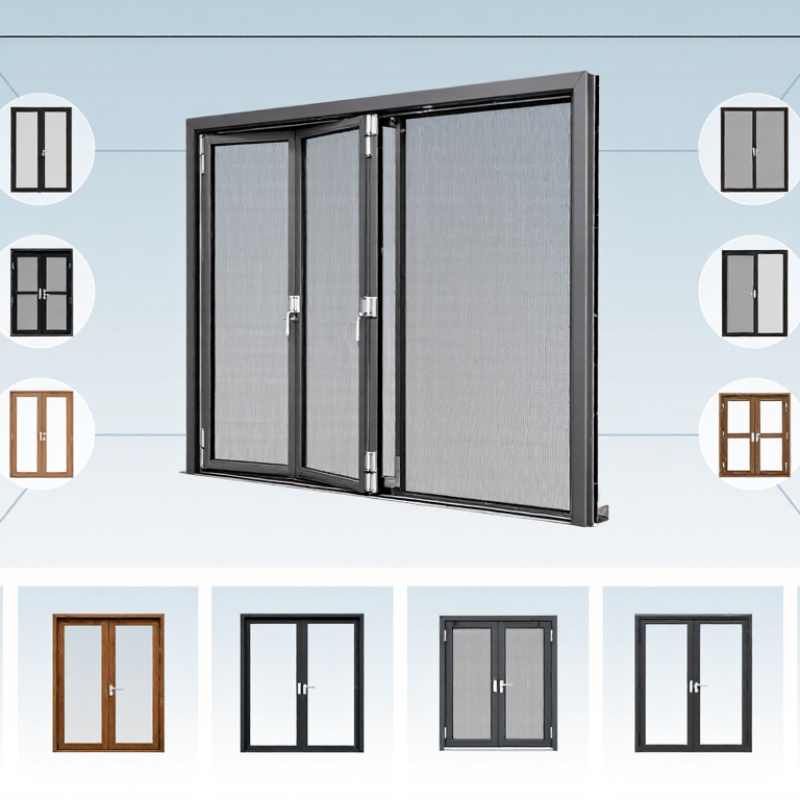
What Are Folding Mesh Doors and How Do They Work?
What Are Folding Mesh Doors and How Do They Work?
Folding mesh doors combine a pleated screen with a compact side frame. Instead of rolling upward, the mesh folds sideways along a track. A handle pulls the screen across the opening, while magnets or a latch hold it closed. Small rollers guide the movement. The system needs no wide storage box above the door.
The mesh blocks insects while allowing air and daylight to pass. This matters in warm climates, where natural ventilation can reduce reliance on mechanical cooling. The U.S. Department of Energy reports that windows can account for 25–30% of residential heating and cooling energy use. A screen does not provide insulation, but it can support ventilation when outdoor conditions are suitable. That distinction is often missed.
Industry selection reports, including Freedonia’s Windows and Doors research, identify renovation, airflow, and flexible opening layouts as continuing demand factors. For a top-10 manufacturer comparison, buyers should inspect mesh density, frame rigidity, track clearance, and repair access. A narrow track may look elegant, yet dust can make it difficult to operate. Real homes are less tidy than product brochures suggest. Installation quality remains decisive. Even strong mesh may sag when the opening is poorly measured. In my experience, the best folding door is not always the most expensive one. It is the one that moves quietly, seals consistently, and survives daily handling.
How Are the Top 10 Manufacturers Selected Worldwide?
Selecting the top 10 folding mesh door manufacturers requires more than counting online mentions. A credible review begins with verified manufacturing experience, product consistency, and documented technical knowledge. We examine factory history, material specifications, mesh strength, frame construction, and folding hardware. Evidence matters.
Our evaluation also considers independent test reports, warranty terms, installation guidance, and after-sales responsiveness. Products are checked for smooth operation, stable alignment, corrosion resistance, and safe daily use. Feedback from installers and commercial buyers provides practical insight that brochures often miss. Manufacturing capacity and delivery reliability are reviewed across different regions.
No ranking method is perfect. Public information varies widely, and smaller manufacturers may publish fewer technical documents. Therefore, each company receives scores from several sources rather than one attractive claim. We compare design performance, quality control, customization ability, service coverage, and value over time. Price alone cannot define leadership. A low-cost door may require frequent adjustment, while a higher-priced system may reduce maintenance work. Site conditions also matter, including humidity, wind exposure, opening frequency, and available installation space. These details can change the final order. Continuous review is necessary because materials, testing practices, and customer support can improve or decline.
Which Companies Lead the Global Folding Mesh Door Market?
The companies leading the global folding mesh door market are not judged by advertising alone. They compete through mesh durability, smooth folding action, and dependable after-sales support. According to Grand View Research, the global doors market continues to expand with residential renovation and commercial construction. This growth creates steady demand for space-saving insect-control systems.
Industry leaders usually provide fiberglass or stainless-steel mesh, reinforced edges, and corrosion-resistant tracks. These details matter in humid coastal regions, where weak rollers can fail quickly. The Freedonia Group’s Windows and Doors analysis identifies replacement activity and construction upgrades as important demand drivers. Manufacturers with regional warehouses often respond faster than companies relying on distant shipments.
Performance testing also separates serious suppliers from low-cost sellers. The American Architectural Manufacturers Association highlights air, water, and operating performance as practical evaluation areas for door systems. Folding mesh doors should therefore be checked for repeated opening cycles, frame alignment, and mesh tension. Installation matters. Even premium materials perform poorly when measurements are inaccurate. That remains an overlooked weakness across the market. Reported market rankings can also be imperfect, because private manufacturers rarely disclose detailed revenue figures. Buyers should compare verified test data, warranty terms, installer training, and replacement-part availability rather than relying on promotional claims.
What Should Buyers Consider Before Choosing a Manufacturer?
Choosing among leading folding mesh door manufacturers requires more than comparing catalog photos. In my experience, buyers should begin with the opening itself. Measure width, height, reveals, floor level, and hinge clearance. A millimeter matters. Ask whether the manufacturer can provide a drawing before production. This step exposes weak technical support early.
Examine mesh material, frame alloy, coating method, and fastening hardware. For humid or coastal sites, request corrosion-test details and care instructions. Check the mesh’s resistance to tearing, pets, repeated folding, and accidental impact. Ask for a sample, not only a brochure. Then inspect edge finishing and track movement by hand. A smooth sample can still hide inconsistent batch quality. Request production tolerances, inspection records, and a clear replacement policy.
Reliable manufacturers explain cycle testing, installation limits, delivery schedules, and warranty exclusions in writing. Verify whether replacement panels and hardware remain available after installation. Compare total ownership cost, including freight, fitting, maintenance, and future repairs. Price alone misleads. Also assess communication during technical questions; slow or vague replies may signal later delays. Document every agreed dimension and finish, because memory is not a quality system. Some buyers overlook installer training, and that mistake can damage an otherwise good door. Leave room to reconsider.