How to Identify Key Circuit Board Components for Your Projects?
In the realm of electronics, understanding circuit board components is crucial for any successful project. Renowned expert Dr. Emily Zhang, a leading authority in circuit design, once stated, “Knowing your components is the first step to innovation.” This highlights the importance of recognizing the various parts that make up a circuit board.
From resistors to capacitors, each circuit board component plays a unique role. They influence performance, efficiency, and reliability in electronic devices. However, many newcomers struggle to identify and understand these parts. Without proper knowledge, projects may hit roadblocks. This journey requires both patience and practice.
Effective troubleshooting often hinges on a solid grasp of circuit board components. Mistakes are common and can lead to significant setbacks. It's essential to reflect on these challenges. Understanding the functions and interactions of components will ultimately lead to greater success in design and implementation.
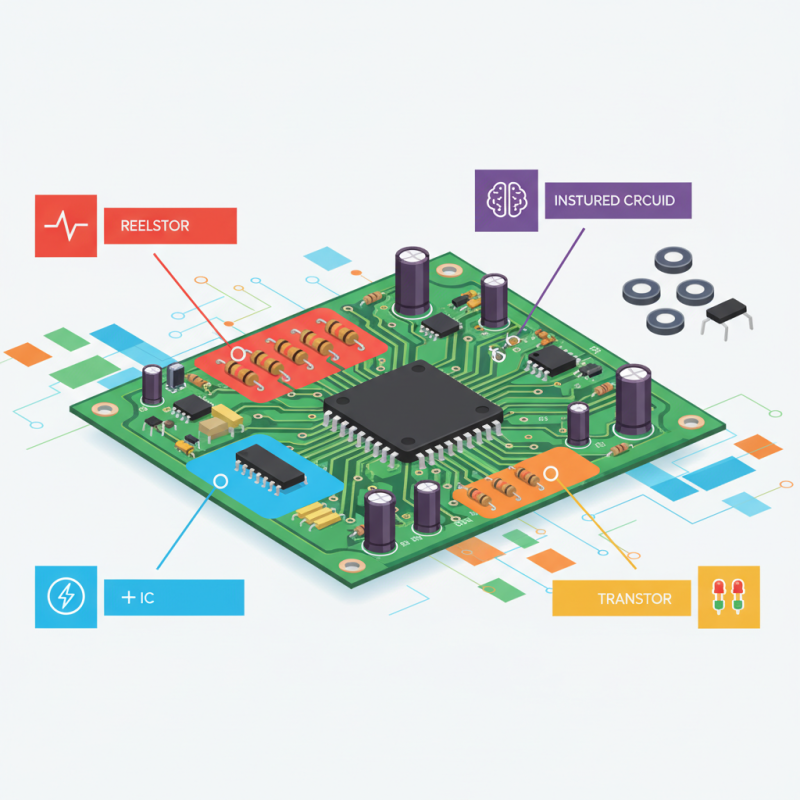
Understanding the Basic Functions of Circuit Board Components
Circuit boards play a critical role in electronic projects. Understanding their components is essential for success. Each part serves a specific function that contributes to the overall operation. Resistors manage current flow, while capacitors store energy. Inductors are used in filters.
Tips: Check resistors for their color codes. This helps determine their resistance values. Also, know where each component fits on the board. Misplacing them can lead to errors in your project.
Another common component is the diode. Diodes allow current to flow in one direction only. This is crucial for protecting other parts of the circuit. If placed incorrectly, it may cause harm. Remember, many boards include integrated circuits (ICs) too. These ICs consolidate numerous functions into a single package, saving space.
Tips: Always consult the datasheet for IC connections. Small mistakes can lead to major issues. Take your time and double-check your work to avoid frustration later.
How to Identify Key Circuit Board Components for Your Projects?
| Component Name |
Function |
Common Symbols |
Types |
| Resistor |
Limits current flow |
R |
Fixed, Variable |
| Capacitor |
Stores electrical energy |
C |
Ceramic, Electrolytic |
| Diode |
Allows current to flow in one direction |
D |
Rectifier, Zener |
| Transistor |
Amplifies or switches electronic signals |
Q |
BJT, FET |
| Inductor |
Stores energy in a magnetic field |
L |
Air Core, Ferrite Core |
| Integrated Circuit (IC) |
Combines multiple functions in one package |
IC |
Analog, Digital |
Recognizing Common Types of Resistors and Their Applications
Resistors play a crucial role in circuit boards. They manage the flow of electric current, ensuring devices function properly. Different types of resistors serve various purposes. For example, carbon film resistors are popular for general applications due to their cost-effectiveness and reliability. In contrast, metal film resistors provide greater accuracy and stability, making them ideal for precision circuits.
Using the right resistor can enhance project performance. It's essential to consider the resistor's tolerance, power rating, and temperature coefficient. According to industry reports, using resistors with lower tolerance can minimize measurement errors. Debugging becomes easier when you use the correct resistors. Understanding their specifications could save time and resources in project development.
Tip: Always double-check the resistance value before soldering. A wrong value can lead to circuit failure. Also, remember to observe the power rating. Exceeding it can cause overheating and component damage. Another tip is to use a resistor color code chart as a quick reference. Familiarity with common resistor types will simplify your design process and help avoid pitfalls.
Identifying Capacitors: Types and Their Roles in Circuits
Identifying capacitors is essential for anyone working with circuits. Capacitors store energy and release it when needed. They come in various types, each serving a specific role. Ceramic capacitors, for instance, are widely used for high-frequency applications. They are relatively small and have low capacitance values. Electrolytic capacitors, on the other hand, offer high capacitance and are useful for smoothing out voltage fluctuations.
When working on your projects, pay attention to capacitor polarity. Many capacitors only work one way. A reversed capacitor can lead to circuit failure. Tantalum capacitors are another common type. They offer stability and reliability but can be costly. Understanding these nuances is crucial.
Always consider the dielectric material in capacitors. Different dielectrics affect performance. For example, film capacitors have low loss characteristics and are great for audio applications. You may encounter different physical shapes and sizes. Take time to double-check specifications. Incomplete or incorrect information can lead to mistakes.
Exploring Integrated Circuits: How to Read Their Specifications
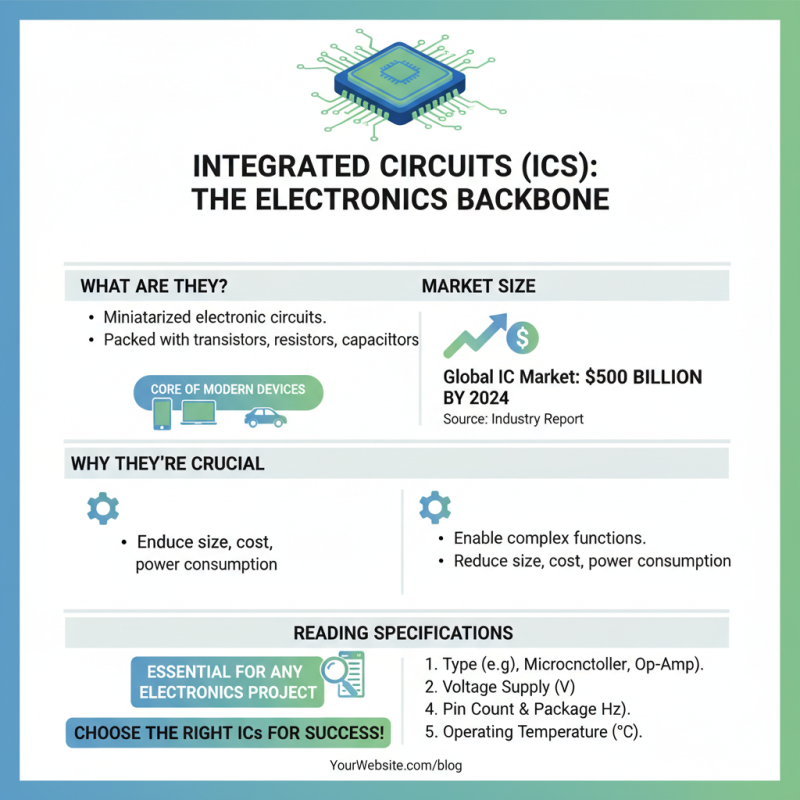
Understanding integrated circuits (ICs) is crucial for any electronics project. These components are the backbone of modern devices, packed with functionality. According to an industry report, the global IC market is expected to reach $500 billion by 2024. Knowing how to read their specifications helps you choose the right ones.
Specifications include parameters like voltage, current, and temperature ratings. A typical datasheet might list a voltage range of 3V to 5.5V. This means your project can operate safely within that voltage. However, designers often overlook thermal limits. An IC might handle up to 125°C, but running at peak temps can shorten lifespan.
When selecting ICs, also consider packaging types. Surface mount technology (SMT) offers size and performance benefits. Yet, hand soldering can be a challenge for hobbyists. It’s vital to find a balance between convenience and functionality. Unforeseen issues can arise if specifications aren’t fully understood. Always double-check datasheets before committing to a design.
Assessing Connectors and Their Importance in Circuit Design
When designing circuit boards, connectors play a crucial role. They create pathways for signals and power. Different types exist, including USB, HDMI, and micro connectors. Each type serves a unique purpose. Understanding each connector's specifications is essential to ensure compatibility. Missteps here can lead to performance issues and project delays.
Often, designers overlook connector placement. Proper alignment can ease assembly and maintenance. Consider the size and layout of your circuit board. A cramped design may complicate connections. Taking time to evaluate spatial requirements is vital. It helps avoid costly modifications later in the project.
Additionally, cable management deserves attention. Poorly routed cables can obstruct airflow and create hazards. It's worth considering how connectors interact with other components. A well-planned design will enhance functionality. Even small tweaks can make a big difference. Aim for a balance between efficiency and practicality. Reflections on past designs can guide improvements in future projects.
Key Circuit Board Components and Their Importance in Circuit Design
This chart illustrates the relative importance of various circuit board components. Understanding these components is crucial for effective circuit design.