

Choosing the right Vacuum Furnace Heat Treatment company can shape product quality, production stability, and long-term operating costs. This 2026 guide examines seven leading providers through practical manufacturing needs, not promotional claims alone. Their capabilities may include vacuum brazing, annealing, hardening, stress relieving, and controlled-atmosphere processing. These services matter when a component requires clean surfaces, tight tolerances, and repeatable mechanical properties.
Details matter.
The review considers furnace size, temperature uniformity, cooling performance, process monitoring, and material experience. It also examines certifications, laboratory support, maintenance response, and evidence from demanding industries. A reliable supplier should explain its thermal cycles clearly and provide traceable records for each batch. Engineers may also need help with loading patterns, fixture design, distortion control, and post-treatment inspection. A bright stainless-steel part leaving the chamber may look excellent, yet appearance alone cannot prove process consistency.
No company is perfect. Public information can be incomplete, and published capacity may not reflect current availability. Rankings can also change when equipment, leadership, or customer support changes. For that reason, this guide treats the seven companies as strong candidates rather than unquestionable winners. Readers should verify lead times, material compatibility, qualification documents, and sample results before making a final decision. The most suitable partner will match the application, production volume, risk tolerance, and technical expectations of each buyer. Practical evidence remains more valuable than impressive language.
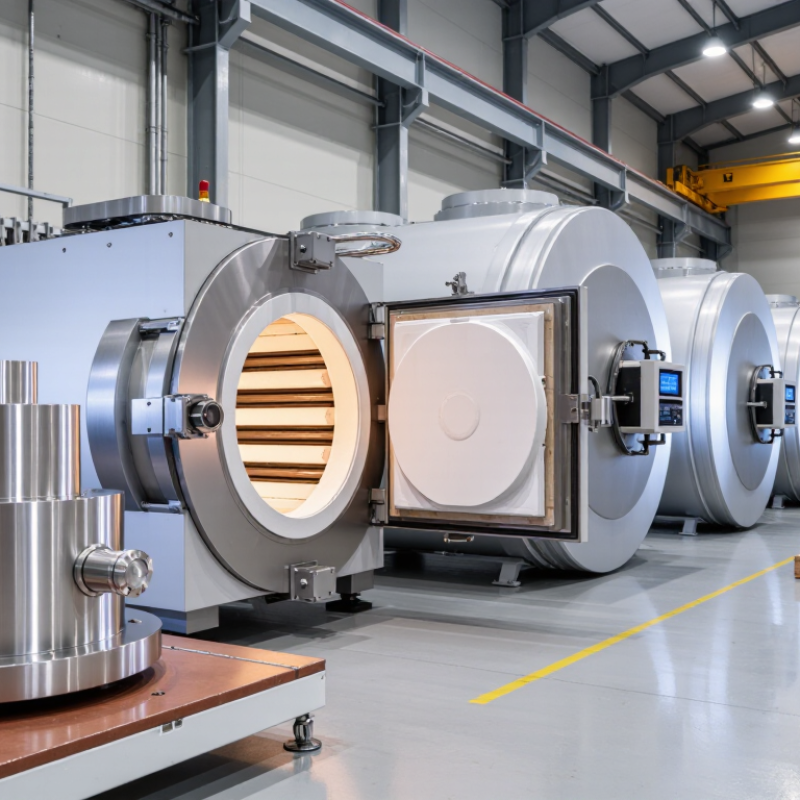
Vacuum furnace heat treatment uses controlled heating in a low-pressure chamber. It removes air, limits oxidation, and protects bright metal surfaces. The process typically includes loading, evacuation, heating, soaking, gas quenching, and cooling. Operators adjust temperature, pressure, and gas flow for each alloy.
The U.S. Department of Energy’s Industrial Decarbonization Roadmap identifies industrial heat as a major energy challenge. Vacuum processing can reduce scale and cleaning work, but it is not automatically efficient. Poor loading patterns can create uneven temperatures. Experienced technicians verify furnace uniformity with calibrated thermocouples and documented surveys. Small mistakes matter. A dense tool-steel load may cool differently from thin aerospace parts.
Industrial uses include tool steels, turbine components, medical implants, powder-metal parts, and additive-manufactured components. These applications need repeatable hardness, controlled distortion, and clean surfaces. World Steel Association data recorded about 1.89 billion tonnes of crude steel production in 2023, showing the enormous scale of heat-treatment demand. However, vacuum furnaces serve selected high-value components rather than every steel product. ASM International guidance emphasizes atmosphere control, material selection, and precise cycle validation. In real production, the hardest decision is often not reaching temperature, but proving uniform results across the entire load. Performance data should include hardness, dimensional change, surface condition, and traceable process records. A perfect cycle on paper can still fail at the shop floor.
Comparison of seven anonymized vacuum-furnace service profiles based on technically relevant selection criteria, including process capability, temperature range, vacuum performance, atmosphere control, material compatibility, quality systems, and typical industrial applications.
| Provider Profile | Primary Process Capability | Typical Maximum Temperature | Working Vacuum Range | Atmosphere and Cooling Options | Compatible Materials | Typical Industrial Uses | Quality and Traceability |
|---|---|---|---|---|---|---|---|
| Profile 1 | Vacuum hardening, tempering, solution treatment, aging, and high-pressure gas quenching | Approximately 1,300°C | Rough vacuum through high vacuum; commonly down to about 10⁻⁵ mbar in the hot zone | Nitrogen, argon, or helium quenching; controlled partial-pressure heating | Tool steels, high-speed steels, stainless steels, nickel alloys, and titanium alloys | Cutting tools, dies, molds, aerospace components, and precision machine parts | Digital batch records, thermocouple monitoring, calibration control, and aerospace-oriented process documentation |
| Profile 2 | Vacuum brazing, stress relieving, annealing, and diffusion bonding | Approximately 1,200°C | Typically 10⁻³ to 10⁻⁵ mbar, depending on load and process | High-vacuum heating with inert-gas backfill and controlled cooling | Stainless steel, nickel-based superalloys, copper alloys, aluminum-compatible assemblies, and ceramics | Heat exchangers, fuel systems, medical assemblies, electrical contacts, and HVAC components | Leak testing, temperature uniformity surveys, filler-metal traceability, and documented braze-cycle control |
| Profile 3 | Large-load vacuum hardening, tempering, annealing, and gas quenching | Approximately 1,250°C | Typically 10⁻² to 10⁻⁴ mbar during heating | Nitrogen or argon cooling; programmable pressure and cooling-rate control | Tool steels, bearing steels, alloy steels, stainless steels, and powder-metallurgy steels | Automotive tooling, industrial gears, shafts, bearing components, and heavy equipment parts | Load mapping, hardness testing, distortion checks, and batch-level process records |
| Profile 4 | Vacuum sintering, debinding support, aging, and stress relieving for powder-based parts | Approximately 1,450°C | High vacuum, commonly reaching about 10⁻⁵ mbar under suitable loading conditions | Vacuum, argon, nitrogen, and controlled partial-pressure sintering atmospheres | Stainless powder metals, tool-steel powders, tungsten carbide systems, nickel alloys, and cobalt alloys | Metal-injection-molded parts, carbide tooling, additive-manufactured components, and wear parts | Density measurement, dimensional inspection, atmosphere monitoring, and sintering-profile traceability |
| Profile 5 | Solution annealing, precipitation hardening, aging, and thermal processing of corrosion-resistant alloys | Approximately 1,100°C | Typically 10⁻³ to 10⁻⁵ mbar, with inert-gas protection where required | Vacuum heating, argon backfill, nitrogen cooling, and controlled furnace cooling | Precipitation-hardening stainless steels, nickel alloys, titanium alloys, and cobalt-chromium alloys | Medical implants, aerospace hardware, chemical-processing equipment, and energy-sector components | Material certificates, hardness and metallographic testing, furnace calibration, and lot traceability |
| Profile 6 | Low-temperature vacuum tempering, stress relieving, and precision thermal cycling | Approximately 750°C | Typically 10⁻² to 10⁻⁴ mbar, selected according to material sensitivity | Vacuum, nitrogen, or argon protection with slow and controlled cooling | Tool steels, stainless steels, aluminum alloys, titanium alloys, and precision weldments | Machined parts, welded structures, optical components, precision instruments, and low-distortion assemblies | Dimensional inspection, temperature uniformity records, hardness verification, and controlled work instructions |
| Profile 7 | Specialized high-temperature treatment, ceramic processing, brazing, and reactive-metal processing | Approximately 1,600°C or higher, depending on furnace design | High vacuum, often around 10⁻⁵ mbar or better before backfilling | High vacuum, argon, helium, nitrogen, and customized partial-pressure cycles | Refractory metals, graphite-containing assemblies, ceramics, nickel superalloys, titanium, and advanced composites | Semiconductor equipment, aerospace research, energy systems, laboratory hardware, and high-temperature tooling | Custom process qualification, vacuum-leak testing, thermal profiling, and engineering-level reporting |
Technical ranges are representative industry values rather than guarantees for a specific facility. Actual capability depends on furnace size, load configuration, material chemistry, required cooling rate, applicable specification, and validated process parameters.