

Choosing the best Ev Power Station for 2026 depends on what you need it to do. Are you seeking backup power during an outage, portable energy for a campsite, or a way to add a little range to an electric vehicle? Those are different jobs. An Ev Power Station may describe a large battery generator, an EV charger, or a system designed to support both. The label alone does not tell you what it can safely power.
For this guide, we’ll compare useful specifications and practical trade-offs: usable capacity, output power, charging speed, portability, battery chemistry, warranty, and price. We’ll also distinguish household backup from vehicle charging. Many portable power stations can run lights, phones, and small appliances, but that does not mean they can recharge an EV efficiently. Check the manufacturer’s compatibility guidance and the vehicle’s charging requirements.
Numbers can mislead. A large capacity figure may look impressive, yet output limits, conversion losses, and charging conditions affect what you get in practice. A heavy unit may work well beside a home, but feel awkward in a car trunk. There is no universal winner. Not quite. The right choice depends on your vehicle, budget, local power needs, and how often you’ll move the unit. We’ll highlight where published specifications help, where they leave questions, and what to verify before buying. That may not produce one perfect pick, but it should make the shortlist more useful.
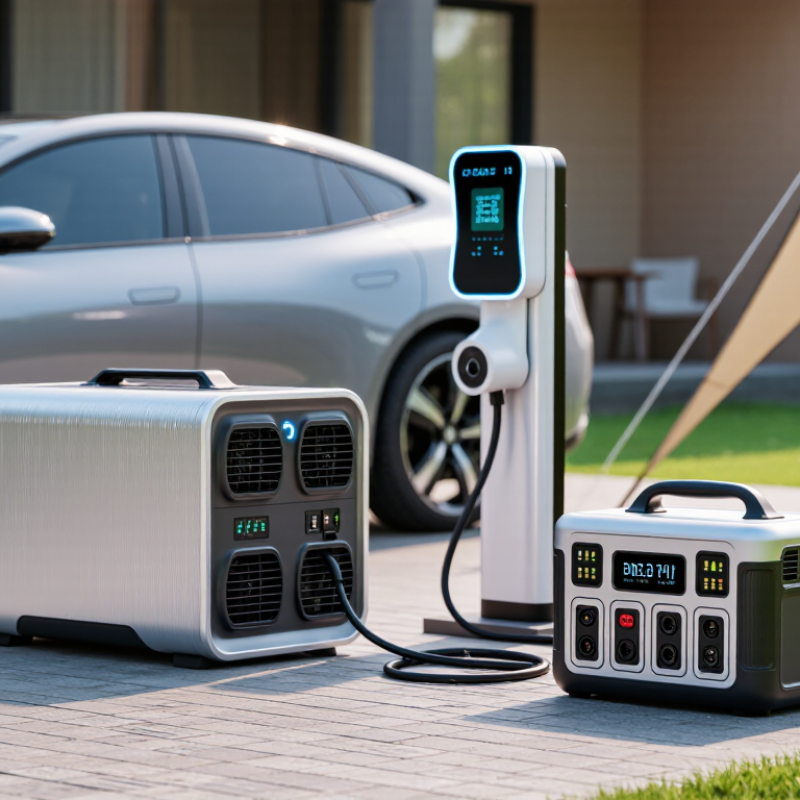
An EV power station, more commonly called an EV charging station, supplies electricity to a vehicle’s battery through charging equipment. It does not simply send power through a cable. The equipment checks the connection, manages electrical flow, and communicates with the car to help charge safely. With AC charging, the vehicle’s onboard charger converts power for the battery. DC fast charging performs that conversion at the station, allowing higher charging speeds. The distinction matters when comparing charging times.
The International Energy Agency’s Global EV Outlook 2024 reported more than four million public charging points worldwide in 2023, a rise of over 40% from the previous year. At home, a Level 2 unit can charge overnight; at a highway stop, a compatible DC fast charger may add substantial range during a short break. Actual speed varies with the vehicle, battery temperature, and charge level. There is no single “best” setup for every driver. A station’s peak output looks useful on paper, but your car may not accept that much power. Check the vehicle’s charging limits and your usual parking routine before choosing. That detail is easy to overlook.
When comparing EV power stations, start with charging speed and vehicle compatibility. A high kilowatt rating is useful only if your car can accept that power. The U.S. Department of Energy’s Alternative Fuels Data Center estimates Level 2 charging typically adds about 10 to 20 miles of range per hour. That makes output and daily driving needs more practical comparison points than peak figures alone. Check connector compatibility, cable reach, and whether the unit can share power across several vehicles. A cable that barely reaches the driveway is a real inconvenience.
Reliability matters just as much. The International Energy Agency’s Global EV Outlook 2024 reports that public charging points grew by more than 40% in 2023, exceeding four million worldwide. As charging networks expand, useful features include remote status monitoring, clear fault alerts, and support for common charging standards. For homes or workplaces, load management can prevent charging from competing with heating or other heavy electrical loads. Look for a weather rating suited to the installation site, too. Rain exposure varies.
Finally, compare installation requirements, warranty coverage, and service access—not just purchase price. Ask whether the station records energy use and can schedule charging during lower-cost hours. No single spec tells the whole story. Product sheets rarely show how a unit behaves during a cold, wet week or after repeated daily use. That uncertainty deserves attention.
EV power stations differ mainly in how they deliver energy, how quickly they charge, and where they make sense. A standard household outlet is the simplest option, but charging is slow. It can suit a driver with a small daily commute and a car parked overnight. Slow, but useful.
A dedicated 240-volt home charger generally adds range faster and fits regular home charging. Installation may require an electrician to check the panel, wiring, and parking location. A DC fast-charging station supplies power much more quickly, but it is typically a public or commercial setup, not a simple home appliance. Charging speed also depends on the vehicle, battery temperature, and station output. The label alone doesn’t tell the whole story.
Portable battery-based stations offer another trade-off. They can provide limited backup charging where fixed charging is unavailable, but stored energy, weight, and recharge time constrain their usefulness. I may be giving portability too much credit; a heavy unit with modest usable capacity can disappoint in real conditions. For 2026, compare charging speed, compatible connectors, installation needs, and the vehicle’s actual charging limit. The best type is the one that fits your parking, routine, and realistic budget.
Match the station to the miles you need, not the biggest number on its label. Check usable capacity in watt-hours, continuous AC output, and whether the unit supports your vehicle’s charging equipment. A standard portable station may provide emergency power, but it cannot replace a large EV battery. A 1-kWh station is only a small fraction of a typical 60-kWh pack, even before charging losses. Small, but useful.
Your routine matters. For a short commute, a station may help top up accessories or provide limited backup power. For meaningful traction-battery charging, check the vehicle’s required voltage and the station’s sustained output first. The U.S. Department of Energy’s Alternative Fuels Data Center estimates Level 1 charging adds about 2–5 miles per hour; Level 2 adds roughly 10–20. Most portable units cannot deliver Level 2 power. That limit is easy to overlook.
For an estimate, multiply your daily miles by your vehicle’s energy use per mile, then allow for conversion losses. Compare that figure with the station’s usable capacity, not just its advertised capacity. Keep the charger cable in mind, too: a high-capacity unit with an incompatible outlet may not help at the roadside. I would size for a real, modest need—not a dramatic worst-case scenario. And leave some margin; actual results vary with temperature, vehicle settings, and charging efficiency.
When comparing an EV power station for 2026, start with your car’s charging limits, not the largest number on a product page. Check the connector type, supported AC or DC charging, voltage, and maximum current against the vehicle manual. A mismatch may mean slow charging or no charging. Small details matter. For home use, confirm the circuit can handle the station’s continuous load. An electrician can assess the wiring, breaker capacity, and grounding. Product labels can be confusing, so verify the manual rather than trusting a short listing. Avoid adapters unless the vehicle and station instructions explicitly support that combination.
Then inspect the safety features and installation requirements. Useful safeguards include temperature monitoring, overcurrent protection, ground-fault protection, and an accessible shutoff. Check for independent safety certification appropriate to your region, and make sure the cable and enclosure suit the intended location. If the unit will sit outdoors, check its weather rating and keep connectors away from standing water. Look for clear instructions on ventilation, cable routing, and regular inspection. I would not assume a weather-resistant case makes every installation safe; placement and wiring still matter. Before buying, compare the station’s output with the vehicle’s onboard charger, since extra capacity may not make charging faster.
| Factor | What to Check | Why It Matters |
|---|---|---|
| Intended use | Decide whether the unit is for emergency backup, occasional roadside top-ups, or regular EV charging. | Most portable power stations are better suited to backup power or slow emergency charging than to routine vehicle charging. Match the unit to the actual use case. |
| Usable battery capacity | Compare usable energy in kilowatt-hours (kWh), not only the advertised battery capacity. Check the manufacturer’s stated output limits and reserve settings. | The usable energy determines how much power is available before recharging. The amount of driving range gained varies with the vehicle, driving conditions, charging losses, and battery temperature. |
| Continuous AC output | Confirm the continuous AC output in watts and amps, and compare it with the EVSE’s input requirements. Do not rely on a short-duration peak or surge rating. | An EVSE may not operate if the power station cannot supply its required current continuously. A higher wattage rating alone does not establish EV-charging compatibility. |
| Charging voltage | Check whether the station provides 120 V AC or 240 V AC, and confirm that the vehicle’s charging equipment accepts that supply. | A 120 V output generally supports only slow Level 1 charging when the EVSE and power station are compatible. Level 2 charging requires a suitable 240 V supply and compatible equipment. |
| EVSE compatibility | Check the vehicle and EVSE manuals for accepted voltage, current, plug type, and minimum operating requirements. Use an EVSE intended for the vehicle and region. | A standard household outlet or adapter does not guarantee that an EVSE will work. The EVSE may refuse to start if its electrical checks are not satisfied. |
| Grounding and neutral configuration | Verify in the power-station and EVSE manuals that their grounding and neutral arrangements are compatible. Use only manufacturer-approved operating modes. | Some EVSEs perform ground-fault and supply checks that can prevent charging from an incompatible power source. Never defeat a ground check or alter wiring to make charging work. |
| Electrical protection | Look for documented overcurrent, overload, short-circuit, overtemperature, and ground-fault protections. Follow the specified outlet and cable limits. | These protections help reduce the risk of equipment damage, electric shock, or overheating. They do not make an unsuitable outlet, cable, or charging setup safe. |
| Independent safety certification | Check for relevant, verifiable safety certifications for the power station and a separate certification or listing for the EVSE, as applicable in your region. | The power station and EVSE are separate products with separate safety requirements. A certification for one does not certify the other or prove that the pair is compatible. |
| Battery chemistry and service life | Review the battery chemistry, warranty, stated cycle-life conditions, and the capacity-retention point used in cycle-life claims. | Cycle-life figures depend on test conditions and do not guarantee a particular service life. A clear warranty and defined test conditions make product comparisons more meaningful. |
| Temperature limits | Check the specified operating and charging temperature ranges for both the power station and the vehicle’s EVSE. Keep the equipment out of conditions beyond those limits. | Battery charging and power output can be restricted by temperature. A cold or hot unit may reduce output, pause charging, or require time to reach an acceptable temperature. |
| Outdoor and moisture protection | Check the ingress-protection rating, if provided, for the power station, connectors, and EVSE. Use outdoor equipment only as its instructions permit. | A rating applies only to the product and conditions specified; it does not mean that equipment can be submerged or used in every kind of rain. Keep connections dry unless specifically rated for the exposure. |
| Recharging and input options | Compare AC recharge time, vehicle or solar input options, and the maximum supported input power. Confirm which accessories are required. | A large battery can take a long time to recharge from a low-power source. Input limits and accessory requirements affect how practical the station is for repeat use. |
| Portability and operating limits | Check the unit’s weight, handles or wheels, cable reach, ventilation clearances, and any restrictions on use inside a vehicle or enclosed space. | High-capacity units can be heavy and require clear airflow. Following placement and ventilation instructions helps prevent overheating and makes setup safer. |
Practical takeaway: The most suitable EV power station is the one whose usable capacity, continuous output, voltage, grounding arrangement, and safety documentation match the specific vehicle and EVSE. Confirm compatibility in both product manuals before connecting equipment.

