What Is Ammonia and What Is It Used For?
Ammonia is a simple molecule with an outsized role in modern life. Its formula is NH3: one nitrogen atom joined to three hydrogen atoms. At room temperature, it is a colorless gas with a sharp, unmistakable odor. You may never handle it directly, yet its products are close at hand.
“ The Haber-Bosch process is the most important invention of the twentieth century,” science historian Vaclav Smil has written. His observation points to ammonia’s central place in producing nitrogen fertilizer. That fertilizer helps crops grow and supports food supplies around the world. Ammonia also serves as a refrigerant in some industrial systems and as a feedstock for making chemicals. Its uses are practical, but they are not all equally visible. A field of green crops may depend on a chemical plant many miles away.
The story has trade-offs. Making ammonia can require substantial energy, and its climate impact depends partly on how that energy is supplied. Concentrated ammonia can also harm people and materials, so industrial handling requires careful controls. Useful, but not simple. This introduction looks at what ammonia is, how it is produced, and where it is used. It also asks a fair question: how can society keep its benefits while reducing its costs? The answer is still developing, and that uncertainty deserves honest attention.
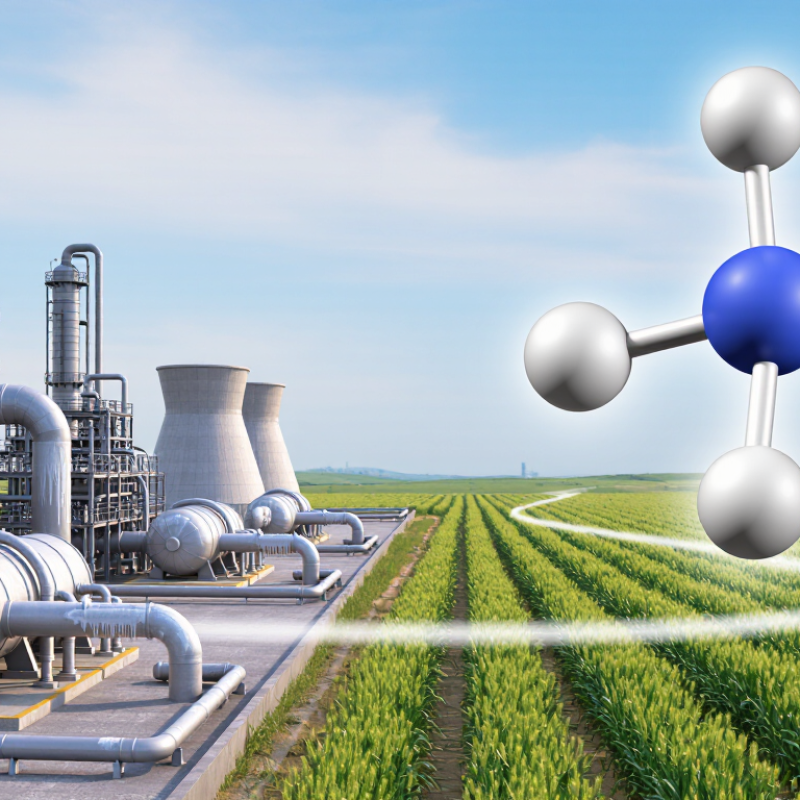
What Ammonia Is and How Its Molecule Is Structured
Ammonia is a simple molecule with the formula NH3. Each molecule contains one nitrogen atom bonded to three hydrogen atoms. The bonds share electrons, but not evenly: nitrogen attracts them more strongly. This uneven sharing gives ammonia a partial charge pattern and makes the molecule polar.
Its shape is not flat. Nitrogen sits above a triangular arrangement of hydrogen atoms, creating a trigonal pyramidal structure. A lone pair of electrons occupies space near the nitrogen atom and helps push the bonds downward. The bond angle is about 107 degrees, slightly narrower than the angle in a flat triangle. A drawing can make the shape look tidy; real molecules are moving constantly.
That lone pair also helps explain ammonia’s behavior. Ammonia molecules can form hydrogen bonds with one another and with water molecules. They dissolve readily in water, where some react to form ammonium and hydroxide ions. The balance depends on conditions, so “ammonia in water” is not just unchanged gas mixed into liquid. At room temperature, pure ammonia is a colorless gas with a sharp odor. Smell is not a safe measuring tool. Its molecular structure helps account for its polarity, water solubility, and noticeable volatility.
What Is Ammonia and What Is It Used For? — What Ammonia Is and How Its Molecule Is Structured
| Dimension | Accurate Description |
| Common name | Ammonia |
| Chemical formula | NH3: each molecule contains one nitrogen atom bonded to three hydrogen atoms. |
| Molecular structure | Ammonia has a trigonal-pyramidal molecular shape. Nitrogen sits at the apex, with three hydrogen atoms forming the base; a lone pair of electrons on nitrogen contributes to this shape. |
| H–N–H bond angle | Approximately 107°, smaller than the 109.5° angle of a perfect tetrahedral arrangement. |
| Molar mass | Approximately 17.03 g/mol. |
| Appearance and odor | Pure ammonia is a colorless gas at room temperature, with a sharp, pungent odor. |
| Boiling point | Approximately −33.3°C at standard atmospheric pressure. Ammonia can therefore be stored as a liquid under pressure or at low temperature. |
| Behavior in water | Ammonia dissolves readily in water. Some dissolved ammonia reacts with water to form ammonium ions (NH4+) and hydroxide ions (OH−), making the solution alkaline. |
| Fertilizer production | A major use is producing nitrogen fertilizers, including urea and ammonium-based fertilizers. Nitrogen is an essential nutrient for plant growth. |
| Industrial chemical feedstock | Ammonia is used to manufacture chemicals such as nitric acid, which is used in fertilizer production and other industrial processes. |
| Refrigeration | Anhydrous ammonia is used as a refrigerant in some industrial and commercial refrigeration systems. It is effective but requires careful handling because it is toxic and corrosive to certain materials. |
| Cleaning products | Dilute aqueous ammonia is used in some cleaning products. Household ammonia is a water-based solution, not the same thing as pure gaseous ammonia. |
| Safety considerations | Concentrated ammonia can damage the eyes, skin, and respiratory system. Use appropriate ventilation and protective equipment, and never mix ammonia-containing cleaners with bleach because dangerous gases may form. |
Important distinction: “Ammonia” can refer to NH3 itself or, in everyday product descriptions, to ammonia dissolved in water. Concentration and form affect its properties and hazards.
Key Physical and Chemical Properties of Ammonia
Ammonia (NH₃) is a colorless gas with a sharp, unmistakable odor. Its molar mass is about 17.031 g/mol, according to the NIST Chemistry WebBook. At standard atmospheric pressure, it boils at approximately −33.3°C and freezes near −77.7°C, figures also listed in the International Chemical Safety Card. That low boiling point matters: under pressure or cooling, ammonia can be stored as a liquid. A small leak may therefore produce a visible white mist as escaping liquid rapidly cools the surrounding air. Small molecule. Strong behavior.
Ammonia is lighter than air; the NIOSH Pocket Guide gives its relative gas density as about 0.60. It dissolves readily in water, forming an alkaline solution, and reacts with acids to produce ammonium salts. In water, the chemistry is an equilibrium, not a simple one-way change. NIOSH reports flammable limits of 15% to 28% by volume in air, although ignition is not its only concern: concentrated vapor can severely irritate the eyes and airways. The odor can warn of a release, but it is not a dependable exposure gauge. That distinction is easy to overlook. These properties help explain ammonia’s use in industrial refrigeration and fertilizer production, while also shaping the ventilation and leak-monitoring practices used around it.
How Ammonia Is Produced and Supplied
Ammonia is made by combining nitrogen from the air with hydrogen under high pressure and temperature. In conventional plants, hydrogen usually comes from natural gas or coal, while the Haber–Bosch process drives the reaction. The International Energy Agency’s Ammonia Technology Roadmap reports global production of about 185 million tonnes in 2020. The scale is substantial. Around 70% goes to fertilisers, so production locations often sit near gas supplies, ports, or large agricultural markets. A plant’s feedstock and energy source matter: they affect both cost and emissions.
After production, ammonia is cooled or compressed for storage and transport. Refrigerated tanks typically hold it near its boiling point of minus 33°C; pressurised tanks are another option. Ships carry large volumes between regions, while rail, road, and pipelines serve shorter routes. The IEA estimates ammonia production caused about 1.3% of global energy-related carbon dioxide emissions in 2020. That figure makes production methods worth examining, not just delivery. Lower-emission pathways can use hydrogen from water electrolysis powered by renewable electricity, but availability and cost remain practical constraints. Supply chains also vary by region, and one plant’s route is not a universal template. That detail is easy to overlook.
Major Uses of Ammonia in Industry, Agriculture, and Daily Life
Ammonia is a colorless gas with a sharp, recognizable odor. It contains nitrogen and hydrogen, and dissolves readily in water. Its importance is less obvious than its smell. Many everyday products and systems rely on it indirectly.
In agriculture, ammonia supplies nitrogen, an essential nutrient for plant growth. It is applied directly in some farming systems or processed into fertilizers such as urea. Farmers use these products to support crops like wheat and corn, though the right amount depends on soil and growing conditions. Too much can harm water quality. That balance is not always simple.
Industry uses ammonia to make chemicals, including nitric acid and materials used in manufacturing. It also serves as a refrigerant in some large-scale cooling systems, such as food-processing facilities. These systems require careful handling because concentrated ammonia can be hazardous. At home, diluted ammonia appears in some cleaning products, while refrigeration and fertilizer use connect it to daily life in less visible ways.
One detail is easy to overlook: smell is not a reliable safety test. Follow product instructions, and never mix cleaners.
Health, Safety, and Environmental Effects of Ammonia
Ammonia (NH₃) is a colorless gas with a sharp, unmistakable odor. It is used in fertilizer production and industrial refrigeration, but its usefulness does not make exposure harmless. Ammonia dissolves in moisture, so the eyes, throat, and lungs can be affected quickly. The U.S. National Institute for Occupational Safety and Health lists 300 parts per million as an immediately dangerous to life or health concentration. OSHA’s workplace exposure limit is 50 parts per million over an eight-hour shift. That limit is not a guarantee of zero risk.
A leak can irritate or burn the eyes and airways; higher concentrations may cause severe lung injury. Odor can warn of a release, but it is not a dependable measuring device. People may adapt to smells, and respiratory protection and evacuation decisions require trained procedures. The numbers matter. So does the setting.
Ammonia also affects ecosystems. The United Nations Environment Programme’s 2021 Global Assessment of Ammonia estimates that agriculture accounts for about 70% of human-caused ammonia emissions worldwide. In air, ammonia can react with acidic pollutants to form fine particles; after deposition, excess nitrogen can contribute to nutrient imbalance in soils and waters. This is easy to overlook when emissions are spread across farms rather than concentrated at one visible outlet. The assessment gives a global estimate, not a precise reading for every region.